Only the Good Die Young– Except for Stan Lee

Screen shot 2014-10-08 at 2.48.54 PMMany years ago, when I was a young man, new to New York and new to being poor and in dire need of a job, I answered an ad in the Help Wanted section of The New York Times for a “lettering artist” at an undisclosed publishing house.

It turned out it was Marvel Comics, the very same company I had once visited a few years earlier in the company of a young woman I was dating at the time. She worked as a freelance letterer for Marvel, and had taken me inside the company headquarters a few times to drop off and pick up work.

June was well-liked, and seemingly quite popular, and it was fun walking down the hall with her.

We passed Stan Lee’s office, his door was open– and he was rocking back in his chair, with his big brown boots on his desk. He was talking on the phone. He looked up as we passed, and I thought I detected a nod of his head and a toothy smile directed toward us, but it could have just been my imagination. I tightened my lips across my teeth, raised my eyebrows and cast a sheepish look in his direction, just in case. He let us pass without beckoning us to enter.

We stopped by a little dark room with one light on a desk. Behind the desk sat a bald man in a white shirt and maroon tie. He was coloring comic book pages. My girlfriend introduced me to him and they chatted amiably for a minute or two. There was a jar of water which sat on the desk in front of him. He held a brush in one hand and every ten seconds or so dipped it into the jar of water. It made a very pleasant sound like a bell as he tapped it against the side of the jar to clean it and switch to a darker color. His name was George Roussos, and he had several aliases, one of which was George Bell.

Proceeding down the hall a little further, suddenly the light in the hallway became noticably darker, as a huge figure of a man entered the hallway from a doorway at the far end. He was so large, he barely fit through the doorway and once in it, he blocked the light. One or two others who also happened to be in the hallway at that moment, stopped as if they had done this many times before, and pressed their backs to the wall in order to let him pass. We also stopped.

This person weighed about 400 pounds and was smoking a pipe of the same type and shape as one I had seen in an old Sherlock Holmes movie many years before.

The giant figure didn’t so much walk, as it lumbered toward us. Then it stopped for a moment and looked down at us in a casual, disinterested way, in the same manner that perhaps some ancient Norse God might have regarded two small birds fluttering through a passing cloud far below. I was introduced to my friend’s boss. This was John Verpoorten.

Next stop was the “stat” room, where I was cordially introduced to one of my friend’s favorite Marvel staffers,“Stewie” Schwartzberg, a man of thirty-five or so, who seemed as mellow and relaxed standing on his feet all day working a big room-sized camera taking photostats of comics pages, as he would had he been couched in some overstuffed leather chair in front of a fireplace while dressed in a padded silk bathrobe and a pair of slippers.

Then we entered the “bullpen” and I was introduced to the artists who worked there.

First we came to Frank Giacoia, an “inker”. As my friend exchanged pleasantries with “Frankie”, he didn’t so much hold, as he “wielded” a sable brush in one hand, and continued inking newspaper strips which he systematically shuffled periodically and set aside to dry. As they talked, his drawing hand never stopped moving. From time to time, he would dip his sable brush into a jar of ink an arm’s length away at the upper right corner of his drawing board. I noticed that although the opening of the jar was very small, every time his brush went in search or more ink, he managed to dip the brush into the ink without the brush ever touching the sides of the tiny glass jar.

To me that was amazing.

It was like watching someone thread a needle without even looking at the needle! The other arm he kept rigid– and its corresponding hand gripped the top of the drawing board firmly as if to prevent it from flying off somewhere or escaping. Frank seemed to me to be at his second job, his first job, being somewhere in Central Casting for a Damon Runyon film about a former police detective who spends his nights as a private investigator. As if to complete the illusion, his Fedora hat and trenchcoat hung from a hook on a nearby wall.

Then I was introduced to Marie Severin a solidly-built woman in her early 40’s. Marie had an odd energy about her. It was the kind of energy children have when they run down the stairs in their pajamas on Christmas morning. Marie had apparently stepped away from her desk and she held a cigarette between her lips and a comics page in her hand. She had apparently just finished it and was taking it down the hall to Sol Brodsky, whoever he was…..

My girlfriend asked to see it. There was a large green monster-looking character on it. It looked like a friendly Frankenstein in purple pants. I found out later “it” was called The Hulk.  

Continuing on, we came to a man in a yellow sweater. He looked to be in his early 50’s. I was twenty-six. This man reminded me of Perry Como, a singer who was popular on TV and with my grandmother when I was a kid. The fellow looked up from behind his drawing table and smiled as my friend said, “Hi, Tartag.” I thought what an odd name for such a sedate, gentlemanly-looking man in horn-rimmed glasses.

“Tartag—?” That sounded like some kind of game that kids in reform school play during recess.  

In time, we passed the desk of Morrie Kuramoto, another man who looked to be in his early 50’s. He had one cigarette with a couple of inches of ash hanging from it in his mouth and another one with three inches of ash on it  burning in his ashtray.

My friend said, “Hiya, Jap!!” to the guy.

I was shocked and embarrassed.

He put down his racing form and looked at her over the tops of his glasses. Then he grunted, “UHNNN….” 

We walked on.

We entered a small office. There were all kinds of charts with dates on them and X’s. Seated behind the desk was a portly-fellow in his late 40’s with large dark eyes looking at us over the tops of half-glasses. He was talking on the telephone. One elbow was propped on his desk. A long spiral cord stretched between his right hand and the telephone. His other arm formed a right angle and his empty hand rested on his left knee. He brightened as my friend entered the room, winked at her and called her “Junie”.   He seemed to know her better than I did.

I’ll admit, I wasn’t planning on ever having to get a real job.

I was quite sure that as soon as I started showing my artwork to galleries in New York, I’d be selling paintings and sculpture and spending my time in a big studio with fifteen foot ceilings and a giant skylight overlooking the Empire State Building.

I wasn’t looking for a job, but I do remember thinking at the time, “This would be a pretty cool place to work if I ever needed one.”

Besides, I didn’t want to work at the same place as someone who I was dating. And I especially did not want to be competing with her for work.  

But about six months later when she announced, to my surprise, that she was “getting married and moving to Tuscon”,  it ocurred to me that perhaps the time had come to try to get freelance work while waiting for Leo Castelli to call.
Cleaning House

Both of our boys are out of our house now and away in college, so the time had finally come to deal with our other house.

Our other house is the one we moved away from when we moved to our present house and the one we moved to when we left New York City in 1997.

Of course, we brought most of our belongings with us from the old place. On top of all of our tables, chairs, lamps, beds, dishes, pots, pans, artwork, drawing tables, clothing, and sundry belongings there were even a few nice pieces of antique furniture which had been left by the previous tenants, so we brought those, too.

Arriving in our new town in New Jersey, one of the things I discovered that I really liked was that on certain days each year, people would place items which they no longer needed or wanted out by the curb and they were free for the taking by people like me. I began cruising around slowly in the old Pontiac picking through others’ castaways.

In this manner, I obtained even more possessions and brought them home and put them in my house. I picked up an old push mower, like the one I had watched the yard man use when I was a boy. Looking through a pile of books at the foot of someone’s driveway, I discovered an old postage stamp album with a bunch of old stamps in it. It was red and had an embossed Indian in full headdress on the cover. I was never much of a stamp collector, but I couldn’t resist. This stamp collection seemed to be the life’s work of some boy growing up in the days before World War Two. Perhaps he was sickly. He no doubt spent many a rainy afternoon in his room with that album. He may have taken it with him when he grew up and got a house of his own, where it sat for years on a shelf or was stored away in a trunk in the attic. Somehow, it will never be known exactly how, it wound up in a pile of old books at the foot of a driveway.

Of course I took that home.

Old worn out rakes and heavy wooden shovels also found their way from the curb into my garage, but they did no more work.

Aside from whatever possessions my wife and I owned, when my father died and then my mother a few years later, we found ourselves going through the contents of the house where they had lived most of their lives, and were faced with the task of making many decisions about what to keep, what to throw away, what to give away, what to donate and what to possibly sell.

My mother, who was nearly 86 when she died suddenly one night, had lived in that house since she was a ten-year-old girl. My father had grown up in the countryside before World War 1 in rural Georgia with a mindset that you don’t throw anything away because you might need it one day.

The house where they lived was the one in which I grew up and it was full of memories, even after my parents were no longer living there. A part of them and a part of me seemed to live on everywhere you looked.  A cracked rubber band saved in a drawer conjured up images of my father. A burned red wax candle found in another drawer reminded me of my mother during many of the hurricanes we endured in the 1950’s.

My father couldn’t go to work when there was a big storm and I liked being together with them in the house with the wind blowing outside and the candles burning and the rain pounding down on the metal roof. Everywhere I looked, there seemed to be a little part of us in every object they had, from a jar of nuts and bolts which represented my Dad, to a small spool of pale blue ribbon being the faint embodiment of  my mother. So naturally, I put things like that in a box and added them to my life.  

As our two boys grew up, their baby things were put away in a trunk and boxes of old toys made their way into the already full attic or basement. The garage, too was devoid of automobiles and served as additional storage space. I discovered a section of the attic under a spire that had empty space, but no floor. Some boards and several days later there was space there for those old boxes of comic books I had been dragging around with me for twenty years or so that just got older.  

Somehow, my wife and I managed to find a place amid all the clutter of our lives and other people’s lives to lay our heads at night or to sit during the day and work at a computer, or read a book, of which there were shelves and boxes full. “You can never have too many books”, I believed. And I knew one day, I would get around to reading them all, including that book I used to see on the shelf at my mother’s house by James Thurber.  

Over there in the corner of our bedroom was the chair my grandmother had been leaning on on New Year’s Eve 1950 when she fell and broke her hip. And in an adjoining room was the little Victorian Chair that had belonged to my father’s mother and down in the basement were two old rocking chairs from the mid 19th century that had belonged to someone in the family, I’m not sure exactly who.

In the living room was the chair that my mother was always sitting in when we came to visit, the same chair where she was sitting the last time I ever saw her, the day I kissed her goodbye and promised to return in a few months.

When I did come back there was only that chair.

Two days ago, having decided to sell the house it was time to make some hard decisions.

A lot of stuff was going to have to go. I spoke to a nice lady named Marie at South Orange Disposal and she cheerfully told me everything I needed to know about steel refuse containers then dutifully wrote down my credit card numbers. The next thing I knew they had delivered a 12-foot steel container to our driveway.

The bulkhead doors to the basement were flung open, the garage doors were thrown open, and things began to be thrown into it. Aside from various cans of paint, old spray cans of Raid, furniture polish and old rags, into the dumpster went the ventriloquist dummy, in its original box, which my mother had used to entertain customers at her place of business in the late 1950’s. Old 78 records to which, in 1942, my young parents and some of their friends had danced around the living room were tossed into that dumpster like so many old newspapers. And here was my old wooden sailboat with the red sail and there was the device made from blue metal which when placed underneath a basketball hoop caused a lttle bell to ring if the ball went through the hoop.

It was painful to see the table which used to sit next to my grandmother’s bed when she was an invalid get thrown out, but even more painful to keep it and have to look at it again.

Hundreds of old bottles that my boys and I had found on our many walks in the woods or pulled from the mud of a nearby dry riverbed were unceremoniously dashed against the steel sides and bottom of the container. Opening one box which had been hastily packed ten years earlier, following my mother’s death, brought me face to face with my toddler-self as an artist. Inside were the wooden blocks of scrap wood that my father had brought home from some construction project he visited. My father had seen them and thought of me and brought them home for me to play with. Instead I marked on them with crayons. Perhaps I was trying to make them some hue other than the dull brown. My Dad liked visiting construction sites, and had once even designed and built a small house.

He had used the proceeds from the sale of that house to start a family business which my mother operated successfully for 17 years. That laundry was the place where the ventriloquist dummy had made his debut and in fact where he had spent his entire career. He retired years later into a closet in the attic at the top of the stairs. Into the open mouth of the steel container all these items went– and many more which shall remain undescribed.

In the wee hours of the morning it started to rain and the rain fell steadily all through the night trickling over the rifles of  plastic soldiers and soaking the little stuffed bear with the red ribbon around his neck.

The next morning as I was drinking my coffee, outside, there was a sudden loud noise like someone hitting the side of an oil tank with a sledge hammer and a steel cable hauled it all up onto the bed of the truck and slowly drove it all away.

All except for the basketball hoop toy–the same one that rang a little bell when the ball went through the hoop.

It lay in the driveway. It had somehow fallen out of the giant steel container and had even been missed being run over by the truck. I picked it up. Its blue lever now reminded me of a tongue which seemed to stick out impudently at the departing truck.  As the truck rounded the corner I depressed the lever.

It went DING.

Boot Bush

Screen shot 2014-09-19 at 6.57.03 PM I had been doing drawings of boots on blank matchbook covers and selling them on the streets of New York City for about a year.

The drawings of the army boots always sold well and I drew the image so many times I got quite good at drawing it very quickly. It was the same sixty-three marks over and over again. Your hand gets trained by your brain very well after a while. And you can draw it on automatic pilot.

One day I was sitting in my little chair on the street corner cranking out another boot drawing when a couple of Japanese tourists stopped to watch. One turned to the other and said, “Look! It’s as if it’s appearing by magic.”

A year or so later, on a perfectly lovely blue-sky day in early June of 1990, I left my dogs, most of my possessions, my top floor loft in SoHo, and my wife and moved into a 2nd floor loft around the corner and down the street with a friend.

Or rather my wife left me. She just stopped coming home.

I think my friend could see how miserable I was and offered to let me live with him for a few weeks until I could find a new place. He worked in an office and I was alone for most of the day.

Once, before he left for work, he gave me a large squarish sheet of foam core and a large black 1″ Sakura marker. My friend was doing three-dimensional work and I was doing two-dimensional work. It made sense.

I could have drawn a lot of different things with a sheet of foam core and a one-inch thick black marker, but for one reason or another, probably because I had done so many little drawings of boots I decided to draw a big black army boot.

It was the kind I had worn when I was in the service twenty-something years earlier. I was very familiar with it. We polished our boots and laced them up, just so and placed them under our bunks in precisely the right location when we were sleeping. We took good care of those boots because we knew they would take good care of us if the going got rough. But for me, anyway it never did. It only got rough when I got out of the army.

When I was discharged, about the only thing I kept were my boots which I knew would serve me well, since I had recently bought a motorcycle–and it wasn’t the kind you ride wearing flip-flops.

And after a couple of years, when I moved to New York City I wore those boots. To a certain extent, moving to Brooklyn in the early 1970’s made me feel like I was entering a war zone, and I depended on my boots to protect me, at least where my feet touched the ground. There were good reasons why you didn’t walk the streets of Brooklyn barefoot in those days.

Besides, there is a long history of boot imagery in cartooning. Someone in a cartoon was always catching a boot when they were fishing or getting a boot thrown at them.

I suppose if I hadn’t been in the army I wouldn’t have been so interested in boots. They are black, after all, and when you work with black ink on white matchbooks, black things almost beg you to draw them.

When I first began drawing on blank matchbook covers, I had drawn shoes from an old catalogue I’d found somewhere. But soon, I gravitated toward drawing boots.

There is something very no-nonsense about a boot. A boot doesn’t try to be a shoe, a sandal or a glass slipper, or to be anything else other that what it is.

That drawing of the boot came out very well and when my friend came home from work that day, I showed it to him. He seemed suitably impressed. You might even say he even took a shine to it. I liked the surface of the foam core, its light weight and the feel and smell of the marker as it moved smoothly across the board. I thought to myself after I had completed the drawing that I would like to do more drawings like that. I wouldn’t have to wait too long.

In a month or two a friend who owned an art gallery in New York asked me if I wanted to have a show of my work in his gallery. I jumped at the chance and immediately went down to Pearl Paint on Canal street and bought a dozen 4’ X 6’ sheets of one-inch thick foam core and a dozen I” thick Sakura markers.

By this time, it was November and I had moved into my new apartment on 28th Street, between Sixth and Seventh in the Flower District. I secluded myself for four days and produced a series of a dozen large drawings of ordinary objects for my upcoming exhibit. I called the show, “Twelve Ugly Drawings”. My mother had once told me, “Ricky, your drawings are ugly. No one wants to look at ugly drawings.” I was determined to prove her wrong and I was even prepared to mount an exhibit of ugly drawings in New York City to do so.

One of the drawings in that exhibit was an army boot, although it didn’t look nearly as good as the other drawing of a boot which I had done a couple of years before while staying at my friend’s loft. That drawing hung on the wall of Tootsi Plohound in Prince street for months. But this time, owing to a major miscalculation on my part, I made a hasty decision to work in the vertical format, which meant that the upper section of the boot was aligned with the long axis, or height of the support– while the part that one’s foot fit into would up being too short, and had to be fit into the short axis of the width. It looked like an orthopedic combat boot. While many people looked at it, no one wanted to pay $500 for it. It was ugly. My mother was right. Mothers know things.

In October of 1992 Bill Clinton was challenging George H. W. Bush for the presidency. The convention was being held at Madison Square Garden, around the corner from my studio.

I was at home working on something when my future wife’s younger brother came into town to attend the convention. He stopped by my place and asked me if I could draw a picture of Clinton and his running mate, Al Gore arm-in-arm and write the word “EXCELLENT” in big letters over their heads.

I told him I’d need a few days to do it and then he said, “C’Mon—you’re an ARTIST, aren’t you…?”

That kind of pissed me off. I knew I would have to do that drawing, whether I wanted to or not, because I was going to marry his sister and if I didn’t do it, I’d be hearing about it for the rest of my life.

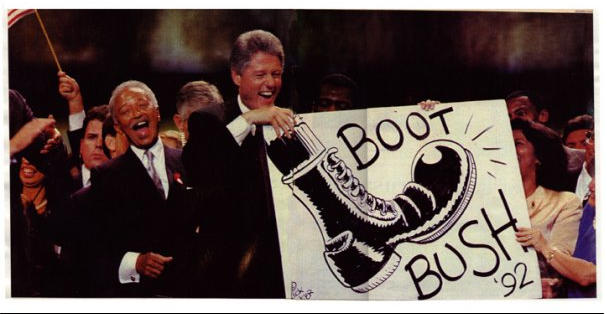
So I knocked it out and he seemed happy with it. As he was leaving, he glanced up and saw the drawing which I had done a couple of years earlier of the army boot. He stopped in his tracks. “Can you do that drawing on the other side of this placard and write “Boot Bush” on it?

Now I was interested. I had done that drawing so many times I literally grabbed the board out of his hands and dashed out the drawing of the boot in a few minutes. He was happy and left saying, “Watch for me tonight on TV.”

I had just gotten in from walking the dog about 10:30 that night when the phone rang. It was my future wife’s mother. She said she had “…just seen Bill Clinton on TV and he was walking around holding my sign.”

Apparently, my future brother-in-law had shown the side with the two smiling candidates on it and Clinton had spotted it from the podium. He shot my brother in law a firm smile and a thumbs-up. And then my brother-in-law, who can apparently read lips in a packed convention hall, saw Bill Clinton say, “I want it!”

So, my brother-in-law, a large man with an even larger sense of purpose began elbowing his way to the front.

When he was close to the stage, Bill Clinton reached down and took the sign and held it up for everyone to see. All the other dignitaries on the podium laughed at what they saw on the back of the sign, but Clinton was mystified.

He had only seen the two smiling candidates. He had not seen the “Boot Bush” part on the back.

He pulled it down– turned it around– saw it and looked really embarrassed.

That’s when the great photo-journalist Richard Thompson, snapped the picture. It was a decisive moment, for Bill Clinton, for George W. Bush and most of all for me. That picture was on CNN, CBS News, was picked up by the Associated Press and distributed all over the country and was a double-page spread in U.S. News and World Report. I thought, “Wow….the future president of the United States likes my work….maybe NOW my mother will like my work….”

No such luck.

Robert Crumb Thinks I’m Weird

Screen shot 2014-09-19 at 11.54.01 AM

“Don’t play with fire”, I remember someone once telling me when I was a kid, although it wasn’t my mother or father. They weren’t full of parental advice.

Growing up with little in the way of adult supervision, I would frequently buy a box matches from the man in the The Soda Shoppe because a box of matches was one of the few things you could buy for a penny in those days and it seemed like a good investment considering all that you could do with fire. I played with fire but I never got burned. I got burned all the time as a kid, but never by fire.

I began drawing on blank match book covers around 1988, during an especially obsessive period in my life during which I was spending most of my waking hours lettering comic books for Marvel. Lettering comic books 14 hours a day is not  particularly creative. Like any artist, I needed an outlet for my creativity.

Drawing on paper seemed somewhat intimidating to me then. There was so much space, ninety-three point five square inches, to be precise. The possibilities were scary. There was just so much that could go wrong in a drawing of that size. I needed something smaller, where the space would be somewhat restricted, as I sensed the scope of my imagination needed limitations.

Almost by accident, I chanced upon the perfect small space for my drawings, especially given the limited time I had to devote to such non-commercial endeavors.

Blank matchbooks.

White ones.

The kind that collected in the bottoms of cigarette machines in bars.

One day, I discovered as I was emptying out my pockets that I often had three or four in my pants pockets after hanging out the previous evening at Smokestacks Lightning, The Nancy Whiskey Pub, Lucky Strike, The Broome Street Bar, Puffy’s or Magoo’s—where I parted with a small fortune in between 1977 and 1987.

One good thing that came out of all this was about 1,000 drawings on blank matchbook covers.

They say, “Nature abhors a vacuum”. And this was never more true as it pertained to my relationship with any blank white space.

I think the first drawing I did on a blank matchbook was of a man’s bald head. I hadn’t yet figured out how to draw hair.

Soon, I was drawing men’s hats from an old catalogue I had found somewhere. Hats held a particular fascination for me since childhood, since my father wore a hat, as did most men when I was a child, and I came to associate hats with manhood. So there are matchbooks with line drawings of fedoras and homburgs.

Another catalogue I picked up somewhere had wonderful illustrations of tools in it.

Blank matchbooks were soon unblanked with small, gem-like and detailed drawings of saws, drills and hammers.

Thanks to all that lettering I had been doing in comics, combined with my fine motor coordination, I had become quite adept at putting down tiny lines exactly where I wanted them using a Hunt’s #102 flexible pen point and a small jar of Higgins #4418 Black India Ink.

Before long, the floodgates of my troubled mind had been thrown wide open and every manner of psycho, convict, ex-convict, loser, schlub, moron and assorted weirdo came poring out of my head, ran down my arm to my fingers, which let them all escape onto one of my many blank match book covers where they remain trapped to this very day.

But pictures alone were not enough. Some literary explanation seemed called for.

Strange things need to be explained.

Fortunately, when the ink was dry, flipping the no-longer-blank matchbook over revealed another blank surface. This seemed as good a place as any to add a name and a little “story” about the person depicted on the other side.

One night I was out walking my dog in the neighborhood when I noticed a shoe store with what I thought was an attractive and artistic display in its window. Remembering that I had once read that one of my art heroes, Andy Warhol, had done drawings of shoes for I. Miller I walked the dog back up to the apartment and came back with my pen and ink and stood there in the darkness and drew “portraits” of the shoes in the lighted store window.

They were nice enough to pose for me.

The next afternoon, I took the drawings into the shoe store, “Tootsi Plohound”, and showed them to the people who were working there. They liked them and placed each little drawing next to its shiny black counterpart.

If I had had any friends at the time, which I did not, I would have invited them to stand around outside the shoe store after closing time with a beer or a glass of wine and perhaps eat little cubes of yellow cheese off a tray with crackers on it.

Around this time, June of 1988, I think I heard on the radio that the famous “underground cartoonist” Robert Crumb would be making a rare public appearance at a store on 8th Street near Sixth Avenue, called The Psychedelic Solution. I had grown up about the same time as Crumb, we had both seen and been influenced by the same newspaper and comic book art and I thought my style and my drawings on matchbooks–and his– were somewhat reminiscent of that style. I decided to go and meet the great artist and give him three of my drawings on blank matchbooks. Remembering from art school that “presentation is everything,” I carefully wrapped the three drawings on matchbooks up in black paper and tied the little package with a silver ribbon.

When I arrived at the venue, there was already a long line all the way down the block. To my temporary disappointment, I discovered that people had already crammed themselves into the building like crosshatching in one of Crumb’s drawings. To make matters worse, the fire marshals weren’t allowing anyone else inside except when other people left. I took my place in line along with hundreds of others and waited for hours.

When my turn finally came to have my moment with the greatest cartoonist who ever lived, as if on cue, I found him characteristically horsing around with a couple of young beauties. He was the living, breathing, fooling-around, fun-loving counterpart to one of his drawings of himself.

“I brought you a present,” I declared from ten feet away.

Eyeing me somewhat warily, as I was dressed all in black and with my black Wayfarer® sunglasses, he slowly asked the woman to his left,

“Would you accept a package… like THIS….. from a guy… who looks like THAT?”

Robert Crumb thinks I’m weird”, I thought.

I momentarily pondered the possibility of having that printed up onto a T-shirt.

Upon opening the package, “R” took a long, slow look at my drawings– and then told me that he, too had done drawings on blank matchbook covers.

Damn!!

And there I was…. thinking I had been the only one.

Night Had Fallen–and it couldn’t get up

Screen shot 2014-09-10 at 3.57.34 PM

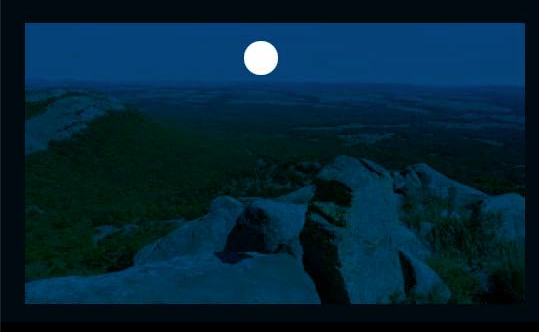
With no map, and no sense of the direction in which to proceed, we picked our way along in the moonlight, across field and stream, between boulders and past dead, gnarled and weathered trees, guided only by our mutual determination to put as much physical and psychological space as our already exhausted bodies and minds would allow, between us and the place we had just “escaped” from. It was now clear to me, that everything so far, had been a “set up”, to insure that all– or most of us, would be captured– and then after subjecting us to a fair amount of degradation, we had been allowed to escape into the wilderness and find our way to the “partisan point” and reunite with the others for the last leg of our ordeal.

Very little conversation passed between my contemporary and me as we trudged on in the darkness, with only the full white moon and billions of beautiful silent stars to light our path. I kept an anxious eye on our surroundings, wary of being recaptured and sent back to the camp. After an hour or so, it seemed increasingly unlikely that we would encounter any other human beings and so I began to relax a little and we slowed our pace somewhat, although we did not stop. I, for one, had no idea whether we were going in the right direction or not and was afraid to ask my companion for fear he would admit that he did not know. I preferred not knowing. Walking along in ignorance was better than embracing the reality that we were lost. 
Around midnight, we heard voices and then realized the voices belonged to two other officer candidates. Now there were four of us. This buoyed my spirits tremendously and put a spring in my step. It was almost like fun as we began to ascend a rocky out-cropping which eventually led us up and over a small mountain. Climbing up and jumping from one large boulder to another, following the blue grey ghostlike figure in front of us, we crested the ridge at the top in the bright moonlight. The moon and stars never shone so bright as they did from the top of that ridge. Looking down from the top, way off in the distance, we saw the tiny yellow headlights of the trucks that were waiting to take us back to the barracks. A most welcome sight.

In another forty mintutes, we had run and tumbled down the mountain in the darkness– and shortly thereafter, had reunited with our fellow candidates to exchange stories. We were all dirty and caked with mud. Uniforms were torn and candidates were limping. It seemed everyone had been captured and taken to the mock POW camp except for this one officer candidate. He had been one of the ones with a map and compass. 

As he told the story: ”In a few hours, I made it to the partisan point!” 

“Then what happened?” we asked. 

He continued: “They congratulated me and they were saying, it was AMAZING that I was the ONLY one who had not been captured. Apparently, this had never happened before in all the history of the program going all the way back to World War 2…. ” 

“Then they told me to come with them by jeep back to the POW camp and tell the camp commandant that I was the first one ever to make it to the partisan point. After about an hour or so, we arrived at the camp. They got on the radio and told him I was coming. When the Jeep pulled up he was waiting for me at the front gate.” 

“And then what happened?, we wanted to know. 

“Well…I went up to him and said, I MADE IT!! I WAS THE ONLY ONE WHO MADE IT TO THE PARTISAN POINT!!” 

“Okay….what did he say to you THEN?”, we asked. 

“Well, he just looked at me for a minute–and then he said……CRAWL PIG!”


My Lucky Day

Screen shot 2014-09-10 at 7.27.47 AM

Lowering oneself down an eight-foot vertical hole in the ground, and then crawling through an opening at the bottom of it into a long tunnel and then crawling on one’s belly to freedom wouldn’t have been so difficult if only I had gone down head first, as the candidate before me had done. 

But for some reason, probably because I am, by nature, a cautious person, I descended feet first to the bottom.

As a result, I found myself standing atop several dead animals at the bottom of a very narrow shaft with about three or four feet of dirt between the top of my head and ground level. The problem was that the shaft was too small to turn around in, and crawling back up and starting over seemed impossible. So I did what anyone else in my situation would have done. 


I worked my feet and legs into the opening of the tunnel, sat down on my ass and began shimmying my way feet first– and flat on my back through the tunnel to safety. There was no light, and I had no idea how long the tunnel was. It was an uncomfortable and awkward way of crawling, to say the least, and with every movement I made, dirt from the tunnel dribbled into my wide-straining eyes and into my open and gasping mouth. 

I took some comfort from the knowledge that I wasn’t that far behind the candidate in front of me, who grunted and groaned as he moved along. He couldn’t see any better than I could, but there was really only one direction in which to crawl to escape, and at least he had the advantage of crawling on his stomach and crawling head first. 

When he realized my predicament, I remember him asking me, there in the darkness, “…why the Hell are you crawling on your back instead of your stomach?”

His question was quite valid, but it had the immediate effect of making me feel quite stupid. I didn’t know what to say, or how to answer him. I’m not sure if I even knew how I had wound up in this position, myself. Plus, it didn’t really seem like a good time to be discussing it, so I just grunted a little louder with a tone of slight desperation, hoping to elicit some sympathy from him instead of derision. 

Fortunately, I don’t think we had to crawl more than about twenty or thirty yards before we began to see some light– and shortly, we came to the end of the tunnel. The tunnel ended abruptly at another vertical shaft, but this one seemed to be only about five or six feet deep, which meant that we had been crawling slightly uphill. It’s hard to gauge angles when you’re scrunching along flat on your back with a face full of dirt. 

There was just enough room at the end for him to pull himself out of the tunnel and into a small circular sunken pit about three feet in diameter. When I got to the end there was only enough room in the pit for my legs. There was no way I could scrunch up the side of the pit feet-first. Fortunately, before I had time to realize how dire my situation actually was, I felt two strong hands grab me around the ankles and with some difficulty, they pulled me up out of the pit. The next thing I knew, I was sitting on the ground next to my “contemporary” and we were free. He was not from my battery and I didn’t recognize him. For just a moment, I wondered what I would have done, had the situation been reversed. He could have easily run off and left me there. But he didn’t. 

I didn’t even thank him.

It was just getting dark. Standing up, feeling the blood return to my legs and actually walking was a really great feeling, which was fortunate, because, even though neither one of us knew it, we still had ten or fifteen miles and a mountain to cross before we would sleep that night. But none of that bothered me. I was free and feeling great and I wasn’t about to be captured again.

As luck would have it, there was even a full moon.

Escape and Evasion

Screen shot 2014-09-09 at 7.57.08 AM

One of the final hurdles we officer candidates had to overcome before becoming 2nd lieutenants in March of 1967, was the Escape and Evasion Course at Fort Sill, Oklahoma, set up in the Wichita Mountains. We were divided up into teams of five candidates, each with a team leader, who was given a compass and a map of the area. I was not that person. 

We carried nothing with us except the uniforms on our backs and a canteen of water. We had been informed that there were “aggressor forces” in the area, whose mission it was to capture us. Our orders were to avoid capture and to rendezvous at the “partisan point” indicated on the map– where we would be given food and further instructions about the location of the next checkpoint. Sounded simple enough to me. 

We arrived by truck, late in the afternoon to begin our ordeal. We were dropped off in an open staging area at the foot of one of the mountains. No sooner had we jumped off the back of the truck, and our boots hit the ground, than we heard machine-gun fire, so we quickly scattered and ran toward the nearest cover, a rocky and brushy area about 50 yards away. I managed to arrive under the shelter of some gnarled trees, along with two others from my team, neither of whom was the team leader with the compass and map. Fortunately, one of the candidates I was with had looked at the map with the team leader, and had a “vague notion” of where the partisan point was. 

We set out and followed a stream which was nestled between some big weathered rocks. We hadn’t gone more than a few hundred yards when we were loudly ordered to “Halt!” by a member of the “aggressor” forces, wearing a green armband and a strange-looking helmet. He was pointing a rifle at us. He had already captured two other members of our team. They stood next to him with their hands in the air. 

We were immediately ordered to sit down on the ground and tie our bootlaces together. This was so we would not be able to run away. It did not occur to me to run away at this point, as the prospect of being free, but alone, in the wilderness seemed worse somehow than being taken prisoner with the others. “ At least I’ll have some company”, I thought. 

We were forced to slowly walk, as best we could, with our laces tied together, for about fifteen minutes, until we came into a densely wooded area. As we got deeper and deeper into the woods, I began to hear voices. They were not happy voices. One of the voices was loud and demanding and all the other voices were subdued and miserable. Soon the source of the voices became quite obvious. 

We were approaching what quickly became apparent was a mock prisoner-of-war camp surrounded by barbed wire. It reminded me of the way Hell was described in Dante’s Inferno, a cheap paperback version of which I had read in the bathroom at my friend Hughie Fillingim’s house many years before. 

There were many different levels of suffering. Over here, there were a bunch of “prisoner” candidates crawling on their stomachs under the weight of a telephone pole. They did not look happy to see us and barely looked up as we passed by on our way into the camp. Off to my right, someone was inserting a large ugly-looking snake head-first through a three inch hole cut face- high into a metal wall locker which had been buried in the earth like a coffin, except that it was only 2 feet deep. Terrible, muffled, desperate, insane screams and pleads to stop were emanating from inside the makeshift coffin. Someone, seemingly, a black guy, based on the sound of his voice, was locked inside, and banging his fists against the sides of the makeshift coffin. Everyone knows that black people are “terrified of snakes”.

I was starting to think that this was unlike other war games I had experienced in basic training. Whoever was running this place was a “RSM”, a Real Sick Mother. We shuffled past several of our captured “contemporaries” whose mud-soaked, but uniformed bodies were wrapped around vertical wooden “Indian Poles”. These future battery commanders and leaders of men were forced to sit cross-legged, “Indian-style”, with large wooden poles, ten inches in diameter, between their legs, the weight of their own bodies cutting off the circulation of blood to their legs. One aggressor had his boot with the full weight of his body pressing on one of my contemporary’s knees, that just wouldn’t seem to go down the way he wanted it to. The candidate was screaming, “You’re breaking my leg!!” I want out of this fucking army, I don’t give a shit about OCS anymore!” I believed him.

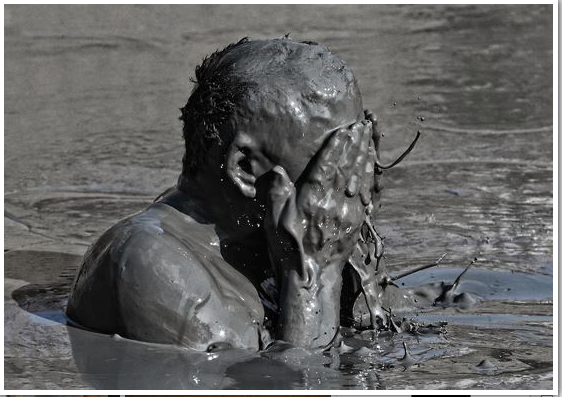
We were led into a barbed wire “POW Camp” and initially to the edge a very large pit filled with mud. It was roughly about twelve by fifteen feet and around three feet deep judging by the slop-encrusted bodies of my contemporaries, who were submerged up to their noses in it. The tops of several helmetless heads completely covered with muck protruded from the pit and several sets of eyes –their faces unrecognizable– silently watched me as I was led into a nearby wire pen, and brought before an “interrogator” seated at a small table in a chair with another chair directly across from him. I was ordered to sit down in the chair– an old wooden school desk to which someone had attached some kind of metal plates to the armrest part and to the slats across the back. There was a leather strap on the armrest and another one across my lap and one for each leg. One of the “aggressors” stood alongside it with a field telephone—the type with a hand crank on it. Wires ran from the telephone to the metal plates on the chair. I immediately realized it was some sort of electrical “torture” device. The assistant reached behind me, pulled up my shirt and forcefully pushed my back in the chair so that bare skin was firmly against the metal plate. Then he strapped my right arm to the armrest and my legs to the legs of the chair. The “interrogator” eyed me with an air of disinterest, a bored, detached look in his vacant eyes.

Anyone who has ever watched a war movie knows that when you are interrogated by the “enemy”, the only information you can give them is your name, rank and service number. I think the interrogator must have seen the same movie I did, because he started with those first three questions, which I dutifully answered. 

I had been asked my name many times before, and felt confident that my answer was correct. When he asked me my rank, I responded “officer candidate”. He seemed surprised by that, but satisfied. Then came my opportunity to rattle off my service number. “US 5-3-4-1-7- 8-4-8.” Not exactly a math problem, but I got it right. Three out of three! I was feeling quite proud of myself. 

Then he asked me, “What unit are you with?” I knew this was one of those questions that I was not allowed to give an answer to, so I didn’t respond. I just sat there. He repeated the question, slightly louder this time, as if I hadn’t heard it the first time around. I still didn’t answer. So he looked up at his assistant who was standing next to me with the field telephone in his hand. The man gave the crank a few turns. 

It was a strange sensation. Not horribly painful. I wouldn’t describe it as a tickling feeling exactly, unless the hand doing the tickling was a metal glove with sharp claws that seemed to be digging at the flesh of my back and arm. At any rate it was only for two or three seconds. My reaction to the sudden shock surprised me—it was loud laughter. 

Then he asked another question: “Who is your unit commander?” Another one which I was not allowed to answer, and he knew it as well as I did. This guy was clearly just going through the motions. This time, rather than sit there in silence waiting for the next jolt, I think I probably tried to postpone the inevitable electric shock by ten seconds or so, by rattling off something to do with “the Code of the Geneva Convention or the Uniform Code of Military Justice,” preventing me from answering his question. He rudely did not wait for me to complete my answer and the next thing I knew I was on the receiving end of a slightly longer dose of electricity delivered to my back and arm. Once again, all I could do was laugh. But slightly longer this time and with noticeably less conviction. Although, really, there was nothing remotely funny about it.

He asked me another question, I think it had something to do with the size of my unit. I thought of saying something like “ten inches”, like Candidate Curley would have done, but thought better of it. I simply remained silent. His assistant used the field telephone to ring me up again, but this time, there was nobody home. It wasn’t funny anymore. Not one Goddamned bit funny. I gritted my teeth, grimaced and when he stopped, a few seconds later, I just looked at him. I didn’t bother to laugh. Clearly I was now much less amused than before, and this time I really, really wanted it to stop. I didn’t think I was going to be able to stand it if they did that again. Fortunately, they unstrapped me and someone led me to a long barbed wire tunnel about two feet high and told me to crawl through it to the end. I was in no position to argue. I didn’t care where it led, as long as it led away.

I got down on my belly and started to crawl in the dirt. I had no idea what was waiting for me at the other end.

“Sit Down, Candidate Parker, You’re Dead…”

Screen shot 2014-09-08 at 1.39.39 PM

January and February on the Great Plains of Oklahoma are cold and harsh and the Winter Wind blows strong and hard with very little in her path but the shivering bodies of Officer Candidates. 

Dressed in long johns, and wearing two pair of socks inside our high, black tightly-laced boots, we sucked-in short, shallow breaths of cold air, then slowly exhaled onto the backs of our wrists. Swaddled, like big green babies in our army fatigues and field jackets (with liner), steel pots atop our wobbly-bobbling heads, an itchy wool scarf about each young neck, we stood, packed together like refugees, clutching our binoculars in our wool-lined, leather-gloved hands. We had come to this vast expanse, where once the buffalo roamed, not to kill any survivors among those few large, majestic beasts, but to become forward observers for the field artillery.

I had decided to become an officer, in part, out of a desire for self-preservation. I was under the mistaken impression that the odds of coming home alive, were I deployed to a war zone, would be somewhat increased were I to become an officer. When I shamefully confessed this to a veteran who had recently returned from Vietnam, I was quickly disabused of this notion. He told me that, in fact, it was quite the opposite. Forward observers had one of the highest casualty rates among our troops in the field. This made me feel somewhat better.

Although I didn’t know it yet, I would “die” that very day, killed by artillery fire, which I myself, had directed onto my own position.


“Sit Down, Candidate Parker, You’re Dead…”

January and February on the Great Plains of Oklahoma are cold and harsh and the Winter Wind blows strong and hard with very little in her path but the shivering bodies of Officer Candidates. 

Dressed in long johns, and wearing two pair of socks inside our high, black tightly-laced boots, we sucked-in short, shallow breaths of cold air, then slowly exhaled onto the backs of our wrists. Swaddled, like big green babies in our army fatigues and field jackets (with liner), steel pots atop our wobbly-bobbling heads, an itchy wool scarf about each young neck, we stood, packed together like refugees, clutching our binoculars in our wool-lined, leather-gloved hands. We had come to this vast expanse, where once the buffalo roamed, not to kill any survivors among those few large, majestic beasts, but to become forward observers for the field artillery.

I had decided to become an officer, in part, out of a desire for self-preservation. I was under the mistaken impression that the odds of coming home alive, were I deployed to a war zone, would be somewhat increased were I to become an officer. When I shamefully confessed this to a veteran who had recently returned from Vietnam, I was quickly disabused of this notion. He told me that, in fact, it was quite the opposite. Forward observers had one of the highest casualty rates among our troops in the field. This made me feel somewhat better.

Although I didn’t know it yet, I would “die” that very day, killed by artillery fire, which I myself, had directed onto my own position.


I HATE MATH

Screen shot 2014-09-08 at 1.28.05 PM

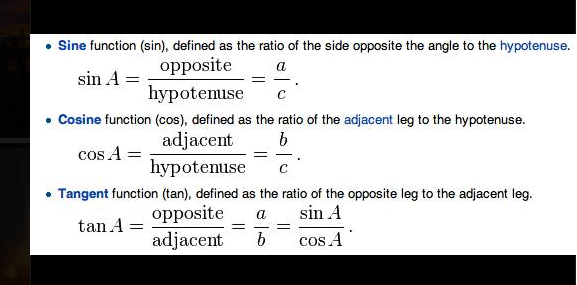
Candidates at the United States Army Field Artillery and Missile Officer Candidate School spend a good portion of their day in the classroom in order to gain a mastery of trigonometry. Briefly, “Trig” is a complicated mathematical science which deals with the angles of triangles and the lengths of their sides. In the case of artillery, one corner of the triangle is the location of the “gun”, the second corner of the triangle is the location of the target and the third corner of the triangle is the location of the “observer” –usually a second lieutenant with a map of the area, a pair of binoculars and a radio operator to transmit his observations concerning the precise location of the “target” to the fire direction control center. 

Each eight-inch howitzer round weighs 200 pounds and is packed with a great deal of explosive firepower. Artillery rounds are large dumb metal objects, which come in various sizes. They are packed with high explosives and once expelled from the barrel or “muzzle” of a canon, will fall to earth under the force of gravity, with potentially deadly force at a point predetermined by “elevation” and “deflection” settings which are “set” on the howitzers by the “gunners” turning dials and knobs on the “guns” or “howitzers”, the things a child playing army might call “cannons”. These crucial settings are usually transmitted by field telephone or radio from a remotely located “FDC” (“fire direction control center”), usually a well-fortified bunker, far back from the line of battle and containing highly-trained officers and men equipped with maps, slide rules and a thorough grasp of trigonometry. 

To be able to “put your balls where the queen wants them” it is absolutely essential to have a good grasp of math. My grasp of math could best be described as a tiny baby trying to hang onto a beach ball by his fingernails. But I had lied my way into the artillery and once there, I was determined to try to learn everything I could, as I was painfully aware that my life and the lives of others, depended on it. Our gunnery instructor was a very trim-looking captain in a starched tan-colored Marine Corps dress uniform. He spoke English, I could hear him and see him quite well. I sat on the front row and looked him right in the eye as he explained sines, co-sines and tangents. When he mentioned the “hypotenuse of a right triangle”, I felt my mind suddenly break free and begin drifting away, like a small boat might drift away from a dock in a swiftly-flowing river, had the rope attached to the mooring suddenly and inexplicably become loose. For a little while, as I drifted downstream in the afternoon sunlight, I could still see his lips moving, and hear the sounds they formed, but, alas, he was speaking a language that I did not comprehend.

Soon, my boat had drifted far downstream, and our instructor had become a fading figure, barely distinguishable from the pilings on the dock.

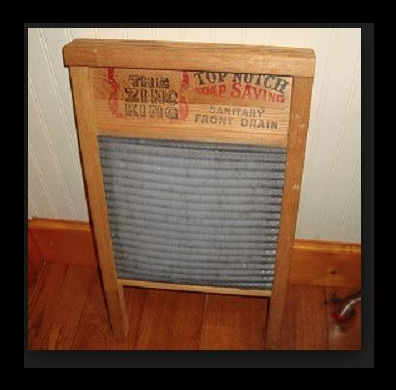
THE WASHBOARD SHOOT

Screen shot 2014-09-08 at 1.16.19 PM

Had it been real, and not merely a training exercise, I would never have known “what hit me”.

This particular “shoot”, was known as the “washboard shoot.” They called it the “washboard shoot” because the terrain was a series of undulating ridges and gullies with brightly painted car bodies scattered about as targets.

I had been the first to give the map coordinates of the “red junk” target, identified by our instructor, which was an old truck body about 1,000 yards distant from our position. This “red junk” target was sitting on a ridge and was plainly visible though binoculars. I called in a “fire mission”, which meant that I had identified a target and given the map coordinates to the fire direction control center. They triangulated it, figured out the powder charge (how many bags of powder to load behind the projectile) and then relayed the “elevation” and “deflection” to the six 155 mm howitzers which had been set up to deliver HE (High Explosive) rounds to the target. The “elevation” is the angle that the barrel of the howitzer makes from the ground and the “deflection” can be thought of simply as how many degrees to aim the barrel to the left or right. I got on the radio.

“Two-four fire mission, over….” 

There was a three second pause and then the FDC echoed it back to me,


“Two-four fire mission, out….” (so far so good). 

I continued with the map coordinates:

“GRID: 4353-7681-9873, over…”


The FDC radioed back: “GRID: 4353-7681-9873, out.” 


While they made the calculations and sent the elevation and deflection settings to the guns, I lifted my field glasses from my chest and tried to hold them at the ready, and tried even harder not to poke my eyes out with them, as my hands, in fact my entire body was writhing uncontrollably from the extreme cold. Or maybe I was just nervous.

In a few seconds, I heard two rounds being fired from the howitzers, which were in place, just as they should have been, far to our rear. 

“Splash, over….” Came back the command from the FDC. 

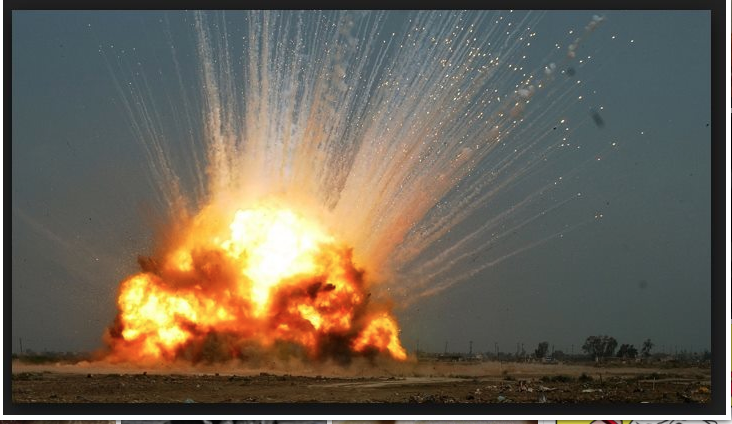
That was my signal to bring my field glasses up to just below my eyes because in exactly three seconds the rounds would impact the target. Then I would see the explosion of the rounds and bring my field glasses up to my eyes, enabling me to visually determine if the rounds were in front of the target–behind the target– or off to the left— or to the right side. Then I could adjust the artillery fire until it was directly ON the target– and then presumably “fire for effect”, that being the final command to fire all six guns at once to completely destroy the target. At least that was the way it was supposed to work. 

Hmmmm…..It had been more than three seconds, and I still hadn’t seen any explosions. This wasn’t good. I could feel my instructor’s eyes, like two blowtorches, burning a hole through the back of my helmet and I could sense the other candidates losing all respect for me. I jammed my field glasses closer to my eyes, as if that would do anything. 

Then from somewhere very far away…… came a faint sound. 

It did not sound like two 155 mm howitzer rounds exploding. The only way I can describe it is that it was the kind of sound one might have heard had one been walking past a bowling alley on a hot summer night, just as the manager opened the front door to the bowling alley to let in some fresh air…. and just as someone else inside rolled a strike. And now imagine that same sound if the bowling alley had been several blocks away. 

This was not good.

“Drop 500, over….” I commanded.

“Drop 500, out….” said the voice on the radio. 

In about eight seconds the voice came back on.

“Splash, over.” 

I repeated the words, “Splash, out…” and once again readied my field glasses. 

This time I saw smoke. The smoke was followed by two distinct impact explosions, one on top of the other. Lifting my glasses to my eyes, I could see the red junk…I could see the smoke…..but…. the wind was blowing the smoke. Was it in front of the target… or behind the target? Shivering and trying to hold the field glasses steady at the same time made it so hard to tell. And it didn’t help that these last two rounds apparently landed in the deep gulley or ravine that was the “washboard” in front of the red junk.Or was it behind it? It was so hard to tell. So I got back on the radio.

“Drop 300….”””…..over”….. seemed like a reasonable compromise.

This time there was no response from the FDC. 


“DROP THREE HUNDRED!” I said again, as if they hadn’t heard me.

Fortunately, the fire direction control center knew the coordinates of our position and would not fire on us no matter how many times I asked.

“Sit down, Candidate Parker, you’re dead, said our instructor.

I did as I was told even though there was no chair.