All posts by richardlowellparker

Rick Parker is an American artist, cartoonist, and humor writer well known in the comics world as the artist of MTV's Beavis and Butt-Head Comic Book (published by Marvel Entertainment 1994-1996). He is also the writer and artist of the self-published graphic novel, "Deadboy", as well as being the illustrator of the Papercutz Slices parody series of graphic novels, "Diary of a Stinky Dead Kid", "Harry Potty and the Deathly Boring", "breaking down", (a Twilight parody), "Percy Jerkson and the Ovolactovegetarians", "The Hunger Pains", and "The Farting Dead". Rick Parker was one of the four artists of The Pekar Project, which brought new original illustrated stories of autobiographical comics pioneer, Harvey Pekar to the web in 2009-2010. His graphic novel, "DRAFTED" about his time in the Army during the Vietnam War will be published Abrams Comicarts in the near future. Rick Parker resides in Maine with his family where he draws cartoons, teaches cartooning and writes this blog.

A Pony Tale

Screen shot 2014-11-16 at 3.56.30 PMAbout forty years ago when I was a young artist and a graduate student at Pratt Insttute in New York City I had a friend who was also an artist and he had long hair, as was the fashion with many young men in those days.

His mother, God rest her soul, had been after him for some time to cut it off.

Her birthday was coming up and my friend got an idea.

He would cut off his pony tail and give it to his mother as part of an artwork.

He carved a small wooden pony out of pinewood. It was sturdy and golden and stood on a small rolling base. He dug out a small opening in the back of the woodcarving into which he was to epoxy in the ponytail, varnished the carving of the pony and set it aside to dry.

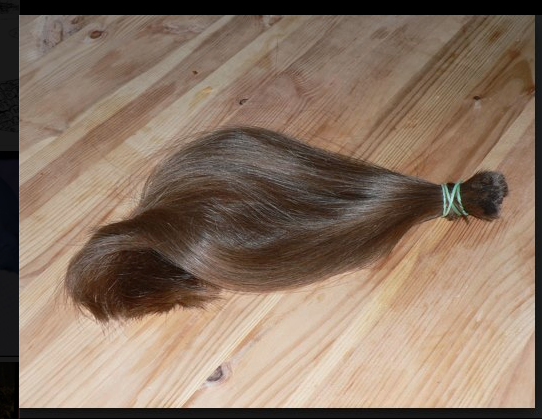
And when his hair was finally long enough, he reached back with a pair of shears and cut off his own hair.

He wrapped a rubber band around it and dipped the ends in epoxy and laid it aside to harden.

That same day I was introduced to him in the sculpture studio where he worked as an graduate-assistant. I needed some help with a project of mine.

We got along surprisingly well, we were two kindred spirits, and at the end of the day, he invited me to come home with him and see his sculpture studio and have dinner with his family. I was single at the time and poor and hungry and, naturally, I accepted. I climbed up into the front seat of his big Chevy truck and we drove off toward the Verrazano Narrows Bridge.

On the way out to Staten Island from Brooklyn, we stopped and, to show my appreciation for his helping me and inviting me to dinner, I bought a six pack of Ballentine XXX Beer, the tall ones. We had a nice time driving out there and drinking and talking. By the time we arrived at his place I had quite a buzz on.

Wanting to be helpful, I picked up three or four of the empty beer cans and put them in a brown paper bag I found on the console between the seats. We went inside and my friend introduced me to his wife, his two small daughters and his dog, Beaver.

While I chatted with the kids and petted the dog, my friend puttered around the kitchen for a few minutes then asked his wife, “Mouse (he called her Mouse)—have you seen a brown paper bag with a ponytail in it?”

“Did it have some beer cans in it,” she asked.

“NAHH!!, my friend responded rather irritated at the thought.

I interjected in a meek manner, “Ummm…as a metter of fact…”

Suddenly he interrupted. “Where is it now?

“I put it outside in the garbage“, she said, still not comprehending the severity of the problem.

My friend ran outside. The garbage men had come early that day, for once in all the years he had lived there. The garbage can was empty and the bag was gone.

My friend’s heart must have sank.

His mother’s birthday was approaching and now he had an unfinished present and short-cropped hair.

The next day, he drove out to the Fresh Kills Landfill and spent hours looking for that brown paper bag.

I can only imagine what must have been going through his mind.

He did not find it in the sea of garbage.

He never gave me a hard time about it or said anything to make me feel bad.

He didn’t have to.

I felt bad enough.

He was the best man at my wedding about 20 years later and we have been friends for life since that first day.

If you ever have a friend, make sure he’s the kind of guy that will look through a mountain of garbage to find something he cares about.

It took a while.

He grew his hair back.

The following year he gave “Pony Tail –a Gift for Mom” to his mother for her birthday.

Screen shot 2014-11-16 at 3.56.30 PMShe loved it.

Is That Your Daughter?

Screen shot 2014-11-12 at 1.41.24 PMIt was well past noon when I woke up and smelled the coffee.

Sherry had a small white Krups® electric coffee grinder and a Chemex coffee pot and she made the best coffee.  The Chemex  was one of those glass coffee pots which is shaped like an hour glass and has a little wooden band around its middle which is held in place by a thin strip of rawhide.  Sometimes I think I would not have been with her if her coffee hadn’t been so good. Sherry also made me a tunafish sandwich every day to take with me to work in my taxicab and together with a Thermos® of her great coffee, she packed it all up quite neatly in a paper towel inside an aluminum lunchbox along with a fresh juicy pear and some alfalfa sprouts.

Five times a week, I’d pull on my jeans, throw on a T-shirt and slip into my boots and brown leather bomber jacket and bomb down the long steps at 240 DeKalb Avenue in Brooklyn. Then I’d fly down into the subway and hop a fast train to Long Island City and get to the garage at 30-19 Northern Boulevard around three o’clock in the afternoon. That’s when Morris Kapner, The Day Man, would bring in IM-19, the yellow Checker Marathon, I’d be driving each night.

Morris, a thin, dried-out looking old fellow with straight, slicked-back white hair and a perpetual look on his face of a man with a bad taste in his mouth, reminded me of Bela Lugosi in civilian clothes. He never looked at me, never spoke to me, never even nodded. He’d pull in, they’d gas it up, and the engine never stopped running.  Morris would slowly collect his trip sheet and his coin changer and his cigar box full of cash and go inside the office. As he was coming in, I’d go out the door, get in and drive away.

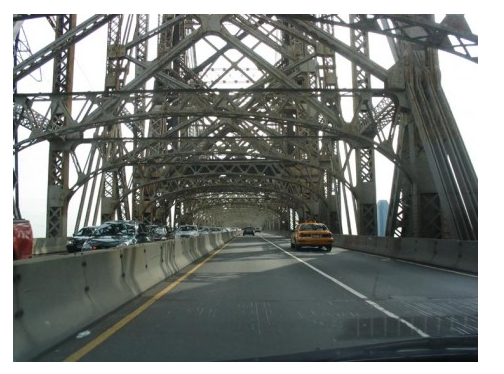
A hundred yards south on Northern Boulevard, I’d take the ramp onto the Queensboro Bridge and step on the gas. When I got to the steel mesh on the bridge the tires made an excited whirring sound and my cab seemed to lift up and float about six inches off the roadway in a giant arc, and I its prisoner, as we hurtled toward the big purple city looming in the distance through the windshield and the steel structure of the bridge and charging toward it, through the swirling thin grey air, as if that taxi was driving herself. And  arriving on the other side of the bridge at 59th Street, she graciously slowed down came to her senses and allowed me to take over for the night.

But this night was going to be different.

I had devised what I thought was a clever and ingenious scheme to make more money in tips.

Before I left the apartment, I had seen a little color photo of Sherry from when she was in the second grade. I asked her if I could have it to carry with me in the taxi cab. I think she was genuinely touched at the idea of my carrying around her picture with me and gladly handed it over. I mounted it on a little piece of cardboard and enclosed it in acetate.

When I got in my cab that afternoon I taped it up on the meter, knowing full well that every passenger always looks at the meter. Any passenger in my cab couldn’t help but notice the smiling little girl with the big blue eyes in the Brownie uniform. I thought, “Maybe if they see that photo, they will think she’s my daughter–and I’ve got a family to support– and maybe they might give me a little extra on the tip.”

I picked up a few fares before anyone commented on the photo. He was a businessman in a grey suit who had hailed me and wanted to be taken to LaGuardia Airport. He seemed in a good mood when he got in and we chatted amiably for a few minutes. I think I was turning off the Brooklyn Queens Expressway into the airport when he looked up to see how much the fare was going to be. That’s when he noticed the photo.

“Is that your little girl?”, he asked in a friendly, upbeat voice, leaning forward in his seat, while taking out his wallet in anticipation of paying the fare.

“Yes,” I said.

“How old is she…? He chirpped.

Then I got an idea. A very bad idea……and responded to his question in a somewhat subdued tone,

“She would have been ten years old today…..” 

He sat back, quiet now… and didn’t say another word.

We pulled up to the departure deck, he opened the door and got out. But not before reaching into his pocket and giving me all the change he had.

My scheme had worked. I felt a little guilty and I took the picture down.

But I kept his money.

The Feet in the Box

New York City in the 1970’s had the most wonderful garbage.

I couldn’t step outside the door in my neighborhood– or walk anywhere– that I didn’t see something interesting which someone had thrown away that I wanted.

Old wooden chairs and metal work tables were forcibly dragged back to my studio. Lamps that needed fixing, old wooden crates and antique steamer trunks that looked as if they had come through Ellis Island got a free ride home on my shoulders.  Hundreds of carved wooden forms for hats from factory buildings in the area suddenly became my property. Factories that had long ago ceased production, and, after years of hibernation, were now being cleaned out and converted to artist’s lofts.

It was in the old Cast Iron District, bordered on the North by Houston Street and on the South by Canal. To the East by Broadway and on the West by West Broadway– a wide cobblestone street, which, in the days when the factories were alive and noisy with work, had been called Laurens Street, and up the center of which, until forty years before I lived there had run the Sixth Avenue Elevated.

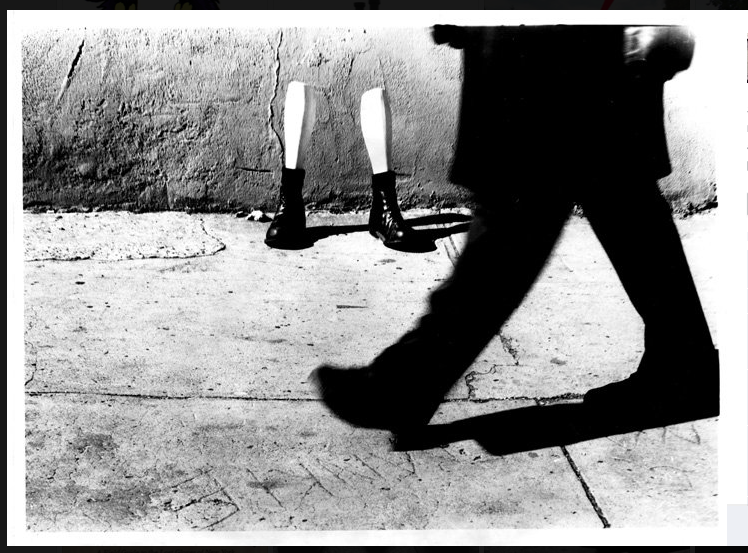
I can’t remember exactly where I found the mannequin legs, but I know I didn’t buy them.  Someone probably threw them out and I brought them home. After all, what man doesn’t admire a nice pair of legs?

At first, I didn’t know what to do with them, but I had recently bought a 35mm camera, an Olympus OM-1, single reflex, and it wasn’t long before I took to the street with my new legs and began taking black and white photographs of them. As fate would have it, it wasn’t long before I chanced upon a Styrofoam® pellet spill of sizable proportions. There was a slight summer breeze and the slow movement of the tiny white pellets across the sidewalk and out into the street reminded me of a lightly falling snow. I put the legs down in the middle of the “snow” and backed up and took a few exposures. It just so happened that the mannequin legs were of the type where there was a slight bend in the “ankles” as if the legs were standing on their tiptoes. Perhaps they had originally been used in conjunction with high heels, who knows. At any rate, I placed them among the windblown pellets, stepped back, set the aperture and shutter speed and released the shutter, deliberately framing the image so as to resemble nothing more than a naked woman standing on her tiptoes in a snowstorm to perhaps kiss the lips of an invisible stranger.

There were other photos, too, like the multiple exposure of the legs, now wearing my old black combat boots, ascending a staircase–sort of a “reverse” homage to Marcel DuChamps’ “Nude Descending a Staircase”, an image which was etched into my mind from childhood days spent in idyl study of pictures in art books and in The World Book Encyclopedia.

But the one image that stood out from all the rest was taken from the sidewalk opposite the disembodied legs and boots against a blue wall near the Southwest corner of West Broadway and Grand Street.

In the picture, there was a sad old woman walking by in a heavy coat. I had seen her before. She lived with her male companion in a tiny upstairs apartment in my building and the pathetic creature wore the same heavy coat whenever they ventured out, which was infrequently, as I recall. I have reason to believe she was probably unclothed except for that coat, as I had seen her once suddenly stop, and unaccompanied on this instance, stooping slightly, she urinated directly on the sidewalk before resuming her liesurely sojourn to wherever it was she was headed.

The Legs in Boots were carefully placed near the wall. The old woman held a crust of bread in her hand, which she was eating as she passed, seemingly unconcerned with the possibility that she might be about to become part of my photograph. I snapped a few quick pictures.

Then the man walked by.

The picture was framed in such a way that the old man is about to pass the disembodied legs in boots which are standing there and his body is framed in such a way that we only see his legs and shoes and part of his coat and coat sleeve and hand holding the crust of bread.

I could not have been happier with the image.

(to be continued)Screen shot 2014-11-11 at 2.23.36 PM

I’ll Trade You My Chicken Soup for Your Soul

I made chicken soup today.

I have never made chicken soup before. I figured I’d give it a try.

I’m not much of a cook but I like chicken soup. It’s supposed to be good for your soul. I figured my soul could use a little help from me.

I drove over to Trader Joe’s and parked the car in their parking lot and locked it.

This is New Jersey, after all.

I grabbed a red shopping cart which was just outside the entrance to the store and went inside.

My wife had told me to get the low sodium chicken broth but as soon as I got inside the door I saw that they had turkey broth on sale. I wondered what chicken soup with turkey broth would taste like. I decided against it. I rolled my cart past the bread and past the coffee display and stopped in front of the chicken broth. I selected two boxes of low sodium organic chicken broth made from free range chickens and headed for the vegetables. I knew from having had chicken soup many times in the past that it’s supposed to have vegetables in it. So I picked up a plastic bag with long stalks of celery in it, a bag of multi-colored carrots. I had never seen yellow or black carrots before, but I thought the colors would look good on a spoon. Then I saw more bags of vegetables. There were Brussell sprouts and white sliced mushrooms and minced onions and yellow onions and green onions. I put them all in my cart, along with a mesh bag of new potatoes. I picked up a bag of mixed vegetables containing cauliflower, more carrots and broccoli. I like broccoli so I got another bag of broccoli just to be sure I had enough. Then I rolled on looking for the chicken. I saw a nice one which said “free range on it.

I momentarily imagined the chicken out west somewhere perhaps wearing a cowboy outfit. I saw in my mind, horses and rattlesnakes and cacti. I imagined the chicken sitting around a campfire at night with other chickens strumming a guitar and singing songs about roping cattle and drinking and pretty lady chickens.

I’ve steamed vegetables before, but I realized I had no idea how to cook the chicken. The package said something about roasting, whatever that was, but that sounded like something that would take too long. I knew that cutting up the vegetables was going to take me some time, but having to roast a chicken just to make soup, seemed like too much work somehow.

I looked around for someone to ask.

A young woman walked by pushing a shopping cart. I quickly sized her up. She didn’t look like she knew any more about chickens than I did.

Then an older woman approached the place I was standing near the Clementines. As she reached for an avocado, I spoke up.

“Have you ever made chicken soup?”

She stopped, looked at me briefly and smiled.

“Yes, I have made chicken soup many times.”

I figured I was off to a good start.

“Can you tell me how to cook the chicken?”, I asked.

“Yes,” she said, “… you have to cut it up first.”

I had cut up other things before in my life–mostly paper and firewood. I had been a cut-up.  I had even carved a few turkeys in my time.

I had never cut up a chicken. But I figured I could do it.

The lady suggested I get some parsley and some paprika. After a few minutes of looking at bags of green things in the vegetable aisle, I finally asked a clerk who was sorting bananas to help me find the parsley– which he did– and then I went back to the spice aisle and although I tried very hard, I couldn’t find the paprika.

So I bought a jar of sea salt and a jar of pepper and a jar of garlic powder and a jar of 21 spices just to be on the safe side.

Then I headed for the checkout line. One of the cashiers was a man, so I passed him by. I was going to ask for more help about making the soup but I didn’t want to ask another man. I didn’t want the soup to taste like a man made it.

While I was sizing up the other cashiers, a friendly young woman came over and said she’d “take me on aisle nine”.

That sounded good to me.

I pushed my cart over to the belt and she began taking everything out and ringing it up. I said,

“I’ll bet you can tell I’m going to make chicken soup, “ I said.

She smiled.

“I have never made chicken soup before,” I offered– hoping she would take pity on me and give me some free advice. She confessed she, herself had only made it a “few times”, but didn’t volunteer any more information on the how she had done it.

I took out my credit card and swiped it through the machine. She put the groceries in my cart and I thanked her and told her I hope she would have a nice day.

Emerging from the store I made directly for my car. Pulling my key from my pocket, I pressed the button unlocking the car. I flung open the tailgate and loaded three bags of future chicken soup into the back. I closed the trunk, walked around the side of the car, opened the door, got in, fastened my seatbelt and backed slowly away from the store as casually as I could, trying not to to draw any undue attention to myelf.

I didn’t want anyone seeing me and thinking, “There goes that idiot with $66 dollars worth of Chick Soup in his trunk.”


As Quiet as a Flower

Twenty-something years ago, I was single again and looking for an apartment near where I worked. Although I worked from home, and had a contract with the company, I deemed it advantageous to be near their headquarters at 287 Park Avenue South, between 27th and 28th Street. I registered with a real estate agency and was soon told of an affordable apartment on 28th Street between Sixth and Seventh Avenues in the heart of New York City’s Flower District.

My previous abode had been pretty quiet, being on the top floor of a loft building on Prince Street. It was peaceful except for about twenty seconds each night when an employee of a bar on the corner of my block would pull down the metal gates covering the store windows around 2:15 a.m., six nights a week. Whoever it was must have been very strong, because you could tell by the sound, that a tremendous downward force had been applied to the handle of the gate, which in turn made a sudden, loud, rushing/rumbling noise, which was quickly followed by a loud SLAM as the gate bottomed out with plenty of leftover force against the steel frame.

Although I was usually still up and working at that hour, that noise never failed to startle me. In time, I took it as a “reverse alarm clock”, my signal to stop working for the day. My father once told me that no one should ever have to work more than 12 hours a day to make a living. Most days, I averaged about 12 hours with plenty of breaks in between.

I confess, I have never liked noise, especially loud noise, as I associate it with danger– and also because it distracts me from my thoughts, and puts me right back in the moment, the here and now, that uncomfortable and unfamiliar place from which I find myself always trying to escape.

When I first went away to college, two friends and I rented a small house adjacent to a fast food restaurant. My room had a window that looked out onto a chain link fence into which someone had woven metal strips so as to make whatever was enclosed by that fence invisible to passersby. Although I didn’t realize it at the time, what was behind that fence a mere ten feet from my bedroom window, was a large steel dumpster into which the restaurant threw all of that day’s garbage.

My very first night there, as I lay sleeping, I had a strange dream. I dreamed I was awakened from a deep sleep in the middle of the night only to find myself in a strange and unfamiliar room. I felt as if I was a guest in someone’s house, but I wasn’t sure whose. In my dream, I was sitting up in my bed and looking out the window. There was a bright light. It appeared to be getting brighter– and in the glow of the light, I thought I could make out the parallel lines of a railroad track leading directly to my window. In addition to the light, there was also the sound of a powerful engine, a wild mechanical tearing and straining which grew louder and louder and threatened to cause the train, or whatever it was which was heading toward me to self-destruct.

I tried to move, to get up out of my bed and run away, before the huge locomotive plowed into my room and smashed me and the entire building into little pieces. But I was frozen in place. It was if my feet and legs weighed a thousand pound each. I couldn’t move. It was a horrible feeling.

Just before the train hit me, I woke up to find myself sitting bolt-upright in bed.

I think it must have been around two-thirty in the morning. There was a terribly loud noise outside my window. It sounded like the throttle on the motor on a runaway truck was stuck wide open and the vehicle would explode at any minute. I got up and looked outside. The two white headlights on the truck seemed to shine right into my face. Two giant steel arms from the front of the truck reached out menacingly. The truck moved in for the kill. It stuck its robotic arms into two slots on the steel dumpster and lifted it straight overhead like it was a child’s toy and then shook it several times rocking it to empty it. Each time it shook the container, the metal door of the dumpster slammed against itself like the crash of the symbols in some demented orchestral overture.

Then it set the dumpster back down, withdrew its giant metal arms and slowly backed away. The grinding, straining sounds of the truck faded back into the darkness and I went back to bed.

The same thing happened night after night, but after about a week it never bothered me again.

It was with an ear of caution that I approached any new living situation. This new apartment I was interested in, was near where I worked– and affordable– and the subway was only a few blocks away. The building looked beautiful in the brochure. Most people would have just taken it.

I remembered once, a friend in New York had told me, “Before you rent an apartment, go over to the neighborhood in the middle of the afternoon and see what life is like on the street. That way you can avoid any unpleasant surprises.”

For once in my life,  I actually took someone’s advice.

I took the 7th Avenue subway to the corner of 28th Street and Seventh Avenue and walked about a hundred yards down the block and stood across the street from my future home. I looked up at a beautiful six- story Beaux-Arts building.  There were plant stores up and down the block and plants up and down the sidewalk and once or twice someone passed me with a cart with some ferns on it. A lady in a blue dress exited one of the flower shops and said excuse me. She was carrying a potted plant.

“How much noise can flowers make?”, I asked myself. Satisfied that noise would not be a problem I handed over a deposit on the apartment, a real estate fee, a month’s rent in advance and one month’s rent to be held in escrow.

I moved in that very night.

(to be continued)

Reflections On The Death of a Kitten

It was a Saturday morning and both of my parents were at work.

There was a litter of kittens and they had been born directly under my parents bedroom.

It was the Spring I was eleven, and I had gone into the room to be with Nina, our maid, who was in the process of making my parents’ bed and of whom I was quite fond. I liked talking to Nina. We were both movie buffs and we enjoyed acting out the scenes for each other, of movies we had seen, although in the 1950’s, in Savannah, we couldn’t sit in the same movie theatre.

That’s when I heard the kittens mewing.

I think I must have expressed my desire to crawl under the house and see the kittens because I remember Nina admonishing me in a dire warning not to do it. She said if the mother cat caught the scent of a human on the kittens, she would abandon them.

That was of little concern to me, as during the previous ten seconds I had already formulated an idea in my head that I would crawl under the house, get the kittens and then I would take care of them. The only other person in the house was my grandmother, who had been confined to her bed or in her wheelchair for the past eight years and  need not be consulted in such matters.

I had seen the mother cat several times over the past few weeks–a large orange and white female with a sagging belly,  She had been quickly entering and leaving the underneath part of the house through a small opening in the brick foundation which had been designed to allow access to plumbers or others needing to repair the water pipes. I had even crawled in and out of there a few times myself over the years. It seemed to me that there was something not altogether honest and forthright about her. There was something sneaky about the orange cat–about the way she moved– and in my mind, that gave me all the license I needed to steal her babies.

Heedless of Nina’s warning and reluctant to venture into the darkness under the house alone, I called up my old friend Hughie and told him about the kittens. In a few minutes he came over and the two of us stood on a step stool in my parents’ closet and got my father’s long silver flashlight off the shelf.

Then with no one to stop us, we went out the back door,  onto the screen porch, out the screen door and down the steps to the sidewalk alongside the house. Then we went around the corner of the house and knelt down beside the little opening. Since I held the flashlight, I was the first one to crawl through. Hughie followed me in. The soil under the house seemed to be sandy and dry, unlike the moist black dirt that was in the backyard and posed no problems for us even though there was only enough room for us to crawl on our hands and knees to where the mewing sounds were coming from. In about one minute we were there. I shined the light into the blackness. The mother cat had chosen to give birth in the brick enclosure under my parents bedroom and with Hughie following me, we crawled over and reached down and scooped up the two mewing kittens and now crawling on our knees and one hand, we carefully carried them back outside and stood up. One was black and one was tiger-striped. Neither one of them had their eyes open yet.

Neither one of them would ever see their mother.

I took the black one and named him Panther. Hughie kept the striped one and named his Tiger. Hughie took his home.  Nina was in the kitchen ironing and  gave me a stern look when I came through the back door. I took Panther into my parents bedroom and placed him on a white towel inside a wicker laundry basket. He was barely able to crawl. Nina told me I would have to feed him with a doll’s baby bottle, so I went around the corner to Mrs. Hirsch’s Dime Store and bought a baby bottle for a doll. Nina filled it up with milk and I knelt down next to the basket and held the bottle while the little kitten drank from it. After fifteen or twenty minutes, I got bored and went and did something else. Later that afternoon I returned, checked on the kitten , fed him again and went away. The next day I woke up, checked on the kitten, fed him and went over to Hughie’s house. Tiger had died. We played kickball in the driveway for a while, had some lunch and then I asked Hughie if he wanted to go to a movie. He said no. I went home checked on the kitten and fed him and then took the bus alone downton to the Avon Theatre. I had no idea what was playing. It turned out to be Fortunella, a  foreign film by Eduardo De Filippo with Italian subtitles. I struggled through that, feeling rather frustrated and caught the bus back home, entered through the unlocked front door, walked down to the bedroom and checked on Panther.

And, of course, Panther was dead.

I don’t know why, but I was not expecting that. It caught me completely by surprise. I picked the little thing up and held it in one hand. Its lifeless body was still warm.  I talked to it, begged it to open its eyes, but it was too late.

Suddenly, a feeling of tremendous guilt washed over me. This was my fault. I had killed the kitten by neglect.

In about three seconds, I developed a lump in my throat that made it difficult to breathe. Tears welled up in my eyes. I couldn’t control the awful feelings that had suddenly overtaken me. I gently put the dead kitten back down on the white towel in the laundry basket and ran into the bathroom to look at my reflection in the mirror. I wanted to see if this person with these dreadful feelings could possibly be me.

It was.

I suppose I had hoped that someone else was also caring for the kitten, feeding it while I was away. Maybe it was Nina or my Grandmother or my Mother after she got home from work, although I knew I had no reason to think that was the case.

It became abundantly clear to me that it was my fault. I began to sob uncontrollably to the point that my sides were actually hurting. My eyes were filled with tears and my nose was running. I went into the bathroom and got some tissue to wipe my nose. My grandmother was in her bedroom and probably wondered what was going on, but I was too ashamed to face her. Nina had gone home for the day and my parents were out. I had a very hard night.

The next day my feelings had eased somewhat although I still felt terrible. There was only one thing to do at this pont. Give the kitten a decent burial. I called up Hughie and he came over and we got shovels out of the garage and dug a shallow hole in the backyard about fifteen feet from where the kittens had been born.  I put the dead kitten into an old Hellman’s mayonnaise jar whose label I had scraped off and tightened the lid. I thought that should protect him from being eaten by worms.

It was the least I could do.

The Rusty Wrench

Screen shot 2014-11-03 at 9.43.34 AMYears ago, having nothing better to do, I put on even older, shabbier clothes than usual, grabbed a small shovel and drove my green station wagon down to a certain dead end street on the outskirts of Portland, Maine.

A few weeks earlier, an older gentleman I had struck up a conversation with at a yard sale, told me that particular street was a great place to find old bottles.

There is just something beautiful about an old bottle. There is something in the color, or something in the texture, something in the shape, or maybe that it just hasn’t changed its essential nature over time. It feels good to hold one in my hand.

A century ago, in the days before there was any such thing such as indoor plumbing, people used to throw bottles and other items they no longer wanted or needed down into the privy or into the woods behind their houses. When indoor plumbing became commonplace and the privy gradually vanished– but before there was municipal residential garbage pickup– people would often carry their unwanted items and other refuse down to the end of the street in a burlap sack or in a wheelbarrow and just dump it down the hill. And there it would remain, hidden from view, unseen and unloved.

Until I came along.

Gradually, over the ensuing decades, the rain would fall and the wind would blow, and the soft wet ground would swallow up the old worn out shoes, the little lead soldier with the broken arm, the teacup with the chip in it, the glass marbles that the boys no longer played with and the porcelain doll with the blue ribbon in her hair who was missing an eye.

Then, each Spring, the weeds and the underbrush and the blackberry vines would come back in again and thicker each year, until the birds–who were among the last to see the little one-eyed doll–and the crickets and the little furry animals on four legs no longer had to make their way through the maze of broken bottles and rusty pots from Grandma’s kitchen. It all lay underground unseen and forgotten. And the people who had discarded it grew old and died or moved away and their wooden houses just up the street came to be occupied by successive generations of families with no knowledge of or connection to all the buried treasure at the end of their street.

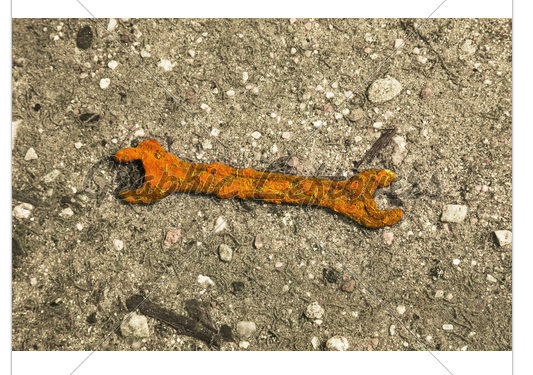
It was there– in the dirt, only eighteen inches below the surface, where I found the wrench. It was made of steel and heavily rusted.  It was long and slender with a small round opening at each end. At one time, it had been sleek and smooth and silver, but no longer.  Now it was orange-brown and heavily pitted. Whatever name and markings it originally had on it had long since vanished. As a tool, it was totally useless–but it was a thing of beauty to me. So, I picked it up, put it in my pocket and took it home.

Years passed.

Going through my possessions in preparation for a move today, I came across that rusty old wrench in a wooden box in the basement. I picked it up, held it in my hand and looked at it. It truly was a thing of beauty. I didn’t think I could keep it. I can’t keep everything. I have too many other things already. I wondered what to do with it. Throwing it away, after what it had already endured seemed out of the question.

Suddenly, I remembered a friend I had made in the last few years, a fine gentleman in his eighties. He arises each day before the sun comes up, and can often be found out in his garage, alone, happily working on the restoration of one or the other of a half dozen different antique automobiles he owns and drives and all of which he has restored from the ground up.

I visited him a year or so ago and complimented him on one of them–a beautiful, new-looking green and yellow 1928 Ford roadster. He told me that he had bought the car for a small sum of money from a farmer’s widow in Maine. The vehicle had sat in the farmer’s shed for fifty-odd years and my friend had tried to buy it–but the farmer wouldn’t sell. Eventually, the farmer died and then the shed died and collapsed onto the vehicle. Over time, and no longer under the protection of the shed and exposed to the elements, the old car had sunk down into the mud up to its axles. The wooden parts of the frame and the wooden spokes of the wheels had rotted away. What remained of the car had become a pile of rusty old parts.

Suddenly, I decided what to do with that rusty old wrench of mine.

I’d wrap it up like a birthday present and mail it off to my friend in Maine.

Surely he’d know what to do with it.

My Brother Was a Dog

teddy100

Teddy was just a dog.

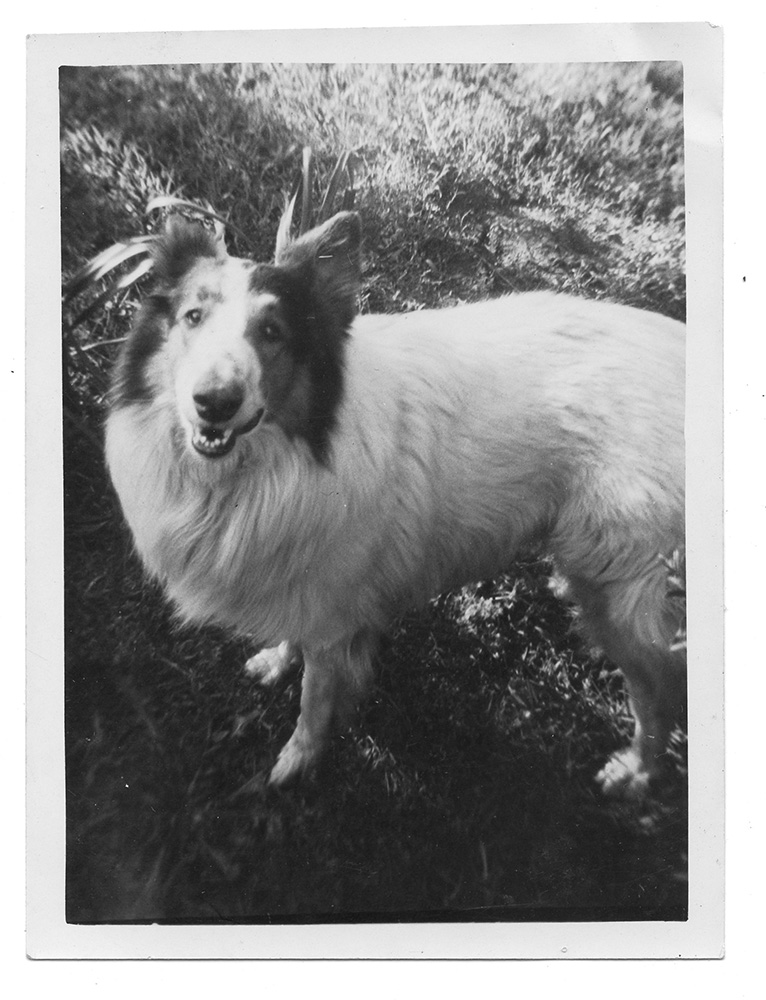
He was a large-sized collie dog who wore a white fur coat trimmed with an orangish-brown mane, all year long, no matter what the weather.

When I was just a month old, and we had driven up from Florida to live with my grandmother and parked the car in the driveway of the red brick house at 727 East 51st Street, Teddy had already been living there since the days before World War II.

He had curled up on the oval- shaped rug in front of the old console radio in the sun parlor and listened along with everyone else in the house as President Roosevelt delivered his Fireside Chats.

Teddy was home that Sunday when the Japanese bombed Pearl Harbor.

When President Roosevelt died suddenly in 1945, the whole country went into mourning, but not Teddy.

Teddy was just a dog.

Later, when the war ended, and people were hooting and hollering and celebrating in the streets, when sailors grabbed nurses in Times Square and kissed them out of pure joy, Teddy went about his life as usual, as if nothing at all had happened.

Teddy seemed big to me and well-established. Quite comfortable in his surroundings. And so, when I was small, he allayed my apprehensions, soothed my anxieties and eased my transition into my new home. I soon came to think of Teddy as my brother.

It was clear to me from the beginning that the two of us were not like any of the others living there.

Teddy and I had a lot in common. We both moved around on all-fours, neither of us could talk, we both slept a lot and were happy to eat whatever they gave us. Everyone seemed to love us a lot, too. But I knew Teddy was special. People treated him differently from the way they treated me. Even though I was just a baby, I could tell. I guess that was because he was older.

There is a picture of Teddy and I playing in the front yard together, but I don’t remember that. I do remember being on the bed in my grandmother’s room one morning when Teddy came in to see what I was doing. From wherever he was, he must have heard me make a sound and known I was awake, and he had come into the bedroom because he wanted to see me–to see if I was doing anything interesting– because when he walked in, I could see his ears were pricked up as if something exciting was going on and he wanted to be a part of it.

I reached out and touched him on the top of his head near one of his ears. He seemed to like it when I did that.

Looking at him, I could tell that he knew things I didn’t know, that he had had experiences I hadn’t had. He was older, after all. He had seen more of life, he had been born at the tail end of The Great Depression, lived through World War II, and he had seen many things. He had seen my mother, my uncle and my aunt move out to start their new lives as adults. He had seen the young servicemen move into their rooms. Rooms he just naturally assumed were his. But he was happy to share. He was good that way.

He had been to all the New Year’s Eve parties and hung out up in the front of the house. He had watched as friendly people came and went through the front door.  He had heard the music on the record player and listened to the voices of family and friends and watched them as they mixed drinks. Once or twice, one or two of the guests had even offered him a cracker with cheese on it. He sat over in the corner by the little table with the lamp on it as they danced around at midnight, wearing funny hats and blowing into little horns, which made a noise, which frankly, he didn’t like.

But he took it all in stride. After all, he had seen a lot in his lifetime.

Then one day, when I was about four, I was out in the back yard looking at the barrel with the strawberries in it, when I heard the screen door to the back porch swing open and I heard the voices of a couple of men. They were not happy voices. The men were my father and my uncle. They were carrying a large wooden box. They were followed out into the yard by my mother and my grandmother. They set the box down by a tree. My father went into the garage and came back with two shovels. He gave one to my uncle and while my mother and my grandmother watched, the two of them dug a large hole in the ground not too far from the larger of the two pecan trees in the backyard. I remember my father took out a white handerchief from his pocket and tied it around his head to keep the salty sweat from his bald head from getting into his brown eyes.

When the hole was deep enough, they put the box with Teddy in it down into the hole. Then they took the shovels and filled the hole back up with dirt.

I didn’t cry, but I could tell from the way the others were acting that something bad had happened.

For years, whenever I played in the backyard, or slept out there in my army tent, I would almost always glance over to the place by the pecan tree where they had put Teddy. In time, the leaves fell and the rains came and the wind blew. After a few years, there was no longer any sign that the ground there had ever been disturbed. And there was no stone or cross to mark his grave.

Every November, when I was a child, I’d go out into the back yard and gather the pecans and my mother would make a pecan pie. I didn’t really want to, but I couldn’t help looking over at the place near the tree where Teddy was. Teddy may have been just a dog.

But he was my brother.

THE INVISIBLE TREE

Screen shot 2014-10-22 at 5.47.20 PM

I never actually saw the tree or even a picture of it–I only heard about it from my father.

It had to have been planted there sometime after 1930. That’s when the house was built.

It was the year after my grandfather had died suddenly at home one night at age 39 of some mysterious illness. After they took his body away, they found my mother, who was 11 at the time, hiding in a closet.

My Grandmother, the mother of his four children, the youngest of whom was my mother, used some of his life insurance money to build the new house. I don’t really blame her for not wanting to sleep in the same room where her husband had died.

Perhaps it was she who had the tree planted in the front yard. It had been a weeping willow. Perhaps the tree symbolized something to her. Perhaps it symbolized the loss of her husband. If it did, she wasn’t the type to talk about such things.

By the time I came along 17 years later, all that was left of the tree was a slight unevenness in the grass where the tree had once stood. When I was a little boy, If I ran across the yard, which I often did, I had to be careful not to trip.

Years later, when I got old enough to mow the grass, the little sunken spot on the lawn was still noticeable.

The tree was there in 1932, when my father first took off from work, for an hour or so, to go to the small red brick house at 727 East fifty-first street to have lunch with my uncle. He and my uncle had met at the Union Station in Savannah, where they both worked. They were both young, and single, and outgoing– and they were both the type who made friends easily. My uncle had invited my father to accompany him to his mother’s house for lunch.

When I was a teenager and interested in such things, my father told me that my mother was just a 12 year-old girl the first time he went there and that “he didn’t pay her much mind.”

I doubt my father paid much mind to the tree either.

It was there several years later when my father would bring my eighteen year-old mother home from the movies and when he picked her up in his green convertible to go for a drive out to Tybee or to the West side of Savannah to watch the Orange Blossom Special pass by.

My father always liked trains.

The tree was still there when my mother posed for a photograph in front of the fireplace in her wedding gown on Saturday, June 24, 1938. If she had looked out the front window of the dining room she could have seen it. It was the type of tree that had long thin branches arcing down gracefully from a thick strong trunk. Each of the branches had little green leaves on them and could be gathered into a bundle, and when my mother was a young girl, she and her friends could have used them to swing on, like Tarzan and Jane did in the movies my mother and her friends went to see at The Lucas Theatre.

If she and her friends ever did swing on that tree, there are no photos of it.

But the tree was there.

The tree blew down on the night of September 20, 1938.  A hurricane that had started off near the Cape Verde Islands, off the West coast of Africa had worked its way eastward across the Atlantic Ocean. That was in the days before hurricanes had names. That unnamed hurricane proceeded up from Jacksonville, one hundred and fifty miles to the South, went right up the Eastern Seaboard and before it finally gave out of breath somewhere in the icy wilds of Canada it had killed nearly 700 people.

And of course our tree.

It was just a tree.

Nobody mourns for a tree.

But I would have loved to have swung on it.

The Invisible Tree

I never actually saw the tree or even a picture of it–I only heard about it from my father.

It had to have been planted there sometime after 1930. That’s when the house was built.

It was the year after my grandfather had died suddenly at home one night at age 39 of some mysterious illness. After they took his body away, they found my mother, who was 11 at the time, hiding in a closet.

My Grandmother, the mother of his four children, the youngest of whom was my mother, used some of his life insurance money to build the new house. I don’t really blame her for not wanting to sleep in the same room where her husband had died.

Perhaps it was she who had the tree planted in the front yard. It had been a weeping willow. Perhaps the tree symbolized something to her. Perhaps it symbolized the loss of her husband. If it did, she wasn’t the type to talk about such things.

By the time I came along 17 years later, all that was left of the tree was a slight unevenness in the grass where the tree had once stood. When I was a little boy, If I ran across the yard, which I often did, I had to be careful not to trip.

Years later, when I got old enough to mow the grass, the little sunken spot on the lawn was still noticeable.

The tree was there in 1932, when my father first took off from work, for an hour or so, to go to the small red brick house at 727 East fifty-first street to have lunch with my uncle. He and my uncle had met at the Union Station in Savannah, where they both worked. They were both young, and single, and outgoing– and they were both the type who made friends easily. My uncle had invited my father to accompany him to his mother’s house for lunch.

When I was a teenager and interested in such things, my father told me that my mother was just a 12 year-old girl the first time he went there and that “he didn’t pay her much mind.” I doubt my father paid much mind to the tree either.

The tree was there when my mother posed for a photograph in front of the fireplace in her wedding gown on Saturday, June 24, 1938. If she had looked out the front window of the dining room she could have seen it. It was the type of tree that had long thin branches arcing down gracefully from a thick strong trunk. Each of the branches had little green leaves on them and could be gathered into a bundle, and when my mother was a young girl, she and her friends could have used them to swing on, like Tarzan and Jane did in the movies in those days. If she did, there are no photos of it. But the tree was there.

It was there when my father would bring my eighteen year-old mother home from the movies and when he picked her up in his convertible to go for a drive out to Tybee or to the West side of Savannah to watch the Orange Blossom Special pass by. My father always liked trains.

The tree blew down on the night of September 20, 1938.  A hurricane that had started off near the Cape Verde Islands, off the West coast of Africa had worked its way eastward across the Atlantic Ocean. That was in the days before hurricanes had names. That unnamed hurricane proceeded up from Jacksonville, one hundred and fifty miles to the South, went right up the Eastern Seaboard and before it finally died in the icy wilds of Canada it had killed nearly 700 people.

And of course our tree.

It was just a tree. Nobody mourns for a tree.

But, when I was a boy growing up in that house I would have loved to have pretended to be Tarzan and swung on its vines.