All posts by richardlowellparker

Rick Parker is an American artist, cartoonist, and humor writer well known in the comics world as the artist of MTV's Beavis and Butt-Head Comic Book (published by Marvel Entertainment 1994-1996). He is also the writer and artist of the self-published graphic novel, "Deadboy", as well as being the illustrator of the Papercutz Slices parody series of graphic novels, "Diary of a Stinky Dead Kid", "Harry Potty and the Deathly Boring", "breaking down", (a Twilight parody), "Percy Jerkson and the Ovolactovegetarians", "The Hunger Pains", and "The Farting Dead". Rick Parker was one of the four artists of The Pekar Project, which brought new original illustrated stories of autobiographical comics pioneer, Harvey Pekar to the web in 2009-2010. His graphic novel, "DRAFTED" about his time in the Army during the Vietnam War will be published Abrams Comicarts in the near future. Rick Parker resides in Maine with his family where he draws cartoons, teaches cartooning and writes this blog.

Thinking Outside the Box

Screen shot 2014-10-21 at 9.54.02 AMWhen I was young, one of the first rights of passage for an artist new to  New York was to show one’s slides to Ivan Karp, owner of the OK Harris Gallery on West Broadway, one of the first art galleries to relocate downtown from the establishment’s 57th Street art scene.

Ivan Karp’s pioneering vision helped establish the Downtown art scene in the blighted commercial district of abandoned cast iron buildings bordered by Houston Street on the North, Canal Street on the South, Broadway on the East and West Broadway on the West. This area would later become what is known today as SoHo. (South of Houston Street) and for a few years, until gentrification, commercial development and an influx of wealthy lawyers and doctors and financial-types moved in, and gradually changed the essential character of the area, it was affordable, and a great place to live– and teeming with artists, bohemians and other creative-types.

Ivan Karp also owned The Hundred Acres Galley which was on West Broadway between Prince and Houston. That gallery was run by Barbara Toll, who, I believe now has her own gallery on Prince Street and was the first dealer in New York to show my work. One day, I just arrived at her gallery with a suitcase full of lithographs. That got her attention.

A couple of years later, when I was a taxi driver, she hailed me on the street, and I drove her to LaGuardia airport. I didn’t say a word to her the whole trip–and she didn’t recognize me. Another missed opportunity.

If I could live my life over again, I would have said, “Hi–you’re Barbara Toll, aren’t you? Do you remember me? You showed my work in the window of your gallery on West Broadway a couple of years ago….”

To which she might have replied, “Oh, yes….I remember you. You were making those things with found objects…what have you been doing lately? Are you still making art?” 

Then, as I weaved in and out of traffic on the FDR Drive, I might have said, “Yes, as a matter of fact, after taking my slides around to various galleries in Manhattan, which were suggested to me by Ivan Karp, I had an epiphany. I realized that I was living in a ground floor storefront in the middle of an area full of artists and others interested in the arts, so I have been doing new work and exhibiting it in the window of my studio for passersby to see. I call it The Barking Dog Museum. It’s just an old milk crate, lined with sheetrock that I painted white. I cut a small hole in the top and there is a small light over it, illuminating it at night. Please stop by and see it if you are in the neighborhood.”

To which I now imagine she would have said, “All right, I will….can you write down the address for me on the back of my business card? In fact, here are TWO of them. Keep one….or better yet, take some color slides of some of your recent work and bring them to me at the gallery. I’ll be back from my trip on Thursday…..”

By then, we would have arrived at the airport, and she would have paid me, even given me a tip. Then I would have hopped out and opened the door for her and said, “Thanks! I’ll see you on Thursday.”I would have wished her a pleasant flight. Then I would have gotten back in my cab and driven away, feeling very hopeful about my prospects for the future, while trying to keep my taxi cab from taking off all by itself, into the clouds, like my spirit would, no doubt, have just done.

But, of course, none of that ever happened. For once, I kept my big mouth shut. And said not a word to her the whole trip.

I did have a big show of my best three-dimensional work at my studio about four years later, to which Ms. Toll was invited. She was kind enough to attend. Afterward, she even told my ex that I had a “great mind”.

I was surprised by her statement.

I wanted to believe her. I really hoped she was right. Although, if true, I wasn’t at all sure what I should be doing with it.
Messing With Lawyers

Screen shot 2014-10-20 at 10.37.12 AMWhen you’re driving a taxi cab in a city with eight million people, it’s rare to see someone you actually know on the street, but it does happen.

I had been driving for about a year when it happened to me.

I was cruising down Lexington Avenue in the 30’s late one afternoon in the fading sunlight between tall buildings looking for a fare, when I happened to spot the older sister of a former girlfriend exiting a swanky bar with a couple of her “rich lawyer friends”. It had been a couple of years since I had seen her.

My girlfriend at the time, had been invited by her recently-divorced older sister to dinner in her new apartment and as a courtesy, my girlfriend had asked me to come along. Unrealistically assuming that perhaps one day this young lady would be my future sister-in-law, and always grateful for a home-cooked meal, I readily accepted. Diane (not her real name) was the divorced mother of a four-year-old girl. It was a pleasant enough evening and, during the course of conversation, she expressed some regret at not being able to take her young daughter to the Thanksgiving Day Parade, as she had to work that day. Being a graduate art student with a somewhat flexible schedule, and, I confess, in a shameless attempt to ingratiate myself with my girlfriend’s sister, I volunteered to return the next day to take her child, who was still in a stroller, to the parade. I remember it being so crowded at one point that I felt it necessary to remove the little girl from the stroller and hold her in my arms to protect her from possible injury due to the masses of people. Although somewhat of a harrowing experience we survived and I returned the child in her stroller to her Mom later that afternoon and went on my way.

A few months later, my former girlfriend suddenly announced to me, upon my arrival at her apartment in Manhattan, that she “was getting married and moving to Tuscon”. Aside from the shock of the news and the accompanying feelings of rejection, I was also a tad annoyed that she couldn’t have just told me over the telephone, and saved me from having to make the long subway trek into Manhattan from Brooklyn. But perhaps she wanted to tell me to my face.

My face wasn’t any happier about it than I was.

To make matters worse, her new fiance was on his way to her apartment that very instant and would be there in a matter of minutes.

For the first time in my life, I felt a strange unwelcome desire overtake me. A powerful feeling that was difficult to control, gradually welled up inside me. I was possessed by a vilolent urge to sieze her and throw her through the third-story window of her apartment and onto the street below.  Getting a grip on my feelings instead of her neck, I tactfully suggested that we leave her apartment and wait outside for Prince Charming to arrive.

In a few minutes a little white imported truck arrived, and its driver got out and casually walked over and kissed my girlfriend on the cheek. It was as if the kiss suddenly transformed her into someone else, someone who was as much of a stranger to me at that moment as he was.

As I stood there dumbfounded, gazing at the two of them, it suddenly seemed to me as if they had been together for years.

He was nothing like me. I thought, “…if this is the person that she chose to be with instead of me, what the Hell was she doing with me….?” It seemed as good a time as any to say goodbye.

And so I did.

And then I turned around and walked back up the block and did not look back.

A few minutes later, feeling like a piece of crap, I descended into the bowels of the subway system and came out in Brooklyn.

I couldn’t escape the feeling that for nearly a year I had been used. That I had been tricked somehow. That I had been played with.

Shortly after that, she called and wanted me to back over. Looking back on it now, I can’t believe I was stupid enough to go. But I did. Apparently stupidity was a part of who I was, at least emotionally.

On the subway back into Manhattan from Brooklyn I had an hour or so to ponder my next move. It should have been to get off at the next stop and go back to Brooklyn.

Of course I didn’t.

When I got to her apartment it was very clear that she was in something akin to a state of mourning, although I realized later that the only thing that had seemingly died was her engagement to be married. I spent the evening babysitting a wounded animal.

In a couple of days I called her again from Brooklyn, she asked me to come right over, and of course, like the fool I was, I did.

We went for a walk in her neighborhood. It wasn’t very long before I learned that all her plans for her future without me were back on again and her hopes for happiness and wedded bliss had been miraculously restored. I didn’t ask for the details.

She left me sitting misty-eyed  on a park bench in front of a high-rise apartment building on the Northeast corner of twenty-third Street and Ninth Avenue. But before she happily walked away she assured me that everything would be all right and that I would eventually find someone else.

Of course she was right.

And in some cases, those women were even worse than she was.

Years passed— and so did any happy feelings I ever had toward my former girlfriend.

In time, those unhappy angry feelings toward her were replaced by an idea, a very bad idea.

An idea that came to me not too long after my former girlfriend’s sister and her two lawyer friends walked out of that swanky bar.

As I got into the left lane, and slowed down and approached, the three of them were walking hurriedly toward the street and it was obvious to me that they were looking for a cab. I was positioned perfectly to make the stop.

They all got into the backseat of the cab, and continued chatting happily.

I pulled away from the curb without asking where they wanted to go and no one bothered telling me. No one had to tell me because I knew where Diane lived, I had been to her apartment for dinner a few years before. I was kind of hoping that Diane would recognize me, but she was so absorbed in talking merrily with her friends that my identity was of no concern to her.

I drove down Lexington Avenue and turned left onto 15th Street and pulled up in front of the doorman building where Diane lived. She said goodnight to her friends got out of the cab and proceeded to go into the building. In one last desperate attempt to enter into her consciousness, I rolled down the window and said, “Good Night, Diane!” to her.

She turned around and smiled. “Oh, Good Night!” she said with a slight chuckle. She still didn’t recognize me and no doubt, assumed that I had overheard her name in conversation as we drove along.

The doorman held the heavy glass door open for her and like her sister before her, she too, disappeared from my life forever.

There was a dead silence from the previously merry young couple in the backseat. “You KNOW her…?” the man asked.

“HER…..??”

“Sure”, I replied. “All the guys at the garage know Diane.”

I then asked where they wanted to go, and they told me Brooklyn Heights.

It was a long way to the Brooklyn Bridge, made somewhat longer as we passed the rest of the trip in total silence.

Hailed by James Van Der Zee

Screen shot 2014-10-20 at 9.33.25 AM

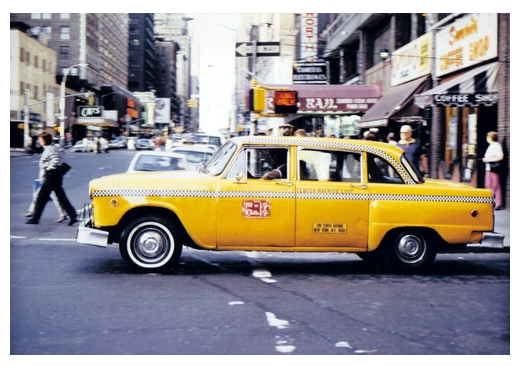
It was around five o’clock on a Spring or perhaps it was a Summer afternoon in 1976 in New York City and I was driving my yellow Checker Marathon Cab slowly North looking for a fare.

I was on Amsterdam Avenue, at about 120th Street the first time I saw him. It would have been impossible not to see him, in fact, as he stood approximately six feet five inches tall. He was dressed in a blue grey suit with white shirt, a long blue tie looped around his neck. He was hatless, as was the fashion in those days, although if there was anyone left in New York who looked like he should have been wearing a dark grey fedora, here was that person. He was a large man and black and the blue of his suit matched the haze of the cataracts in his eyes.

Seeing my cab was empty, he hailed me with a tired, casual gesture of his right arm and hand. I pulled over, somewhat mechanically as if having been summoned by some sort of magical genie from an oil lamp. Although he said nothing about it, I got the feeling that he had hailed at least one other cab in the ten minutes before I arrived on the scene and they had taken one look at him and kept going. He seemed slightly exhausted as he folded his large frame into the right rear passenger area.

I was immediately struck by the contrast between his age and his size. He must have been at least 90 at the time. I didn’t realize old people came that big. He was by far the largest old person I had ever seen. There was an air about him of faded casual elegance and of better times gone by and he seemed to be on some sort of mission.

He asked me to turn the car around and take him to a photography shop downtown between Lexington Avenue and Park. He didn’t remember the street, but he knew where it was and would show me where to turn. When we stopped for the first traffic light he began speaking in a calm and quiet voice. He carefully explained that he wanted to hire me for the afternoon. To take him places and to wait outside for him.

He told me that he and his wife, who was now an invalid, had been forced to leave their brownstone in Harlem, where he had lived and worked as a photographer for decades and they had moved into a tiny modern apartment. He had many negatives of the inside of their old house as well as the old neighborhood and he was searching for a photo laboratory that could blow his negatives up very large. He wanted to use them as wallpaper to decorate his new apartment, so that his wife, who missed their old home, would feel better about her new one.

I loved the idea.

While I sat in the cab with the meter running he went inside the photo store. After about fifteen or twenty minutes, he came back out satisfied that he had a deal. He seemed more relaxed now that he had found someone who could do what he wanted. He was sure that his wife was going to be happy now and stop missing the old home so much. I was touched by the tender way in which he spoke of her. It was clear to me that he must have loved her very much to go to so much trouble and expense to make her happy. I briefly thought about my father and mother and wondered if my father would have gone to such extravagant lengths to please my mother—or whether he would have thought such an idea was silly and a waste of money.

While I pondered such an unlikely scenario and steered the cab through the traffic, he interrupted my musings to direct me to where he wanted to get out. I pulled over and he paid the fare and even gave me a little tip.

As he slowly got out he told me his name—James Van Der Zee— and invited me to come and visit them in their new apartment. I was touched by how excited he was now at the prospect of seeing his idea realized and being able to surprise his wife and to please her.

I promised that I would visit them– and I knew as I was making that promise, that it would never happen.

The Night Man

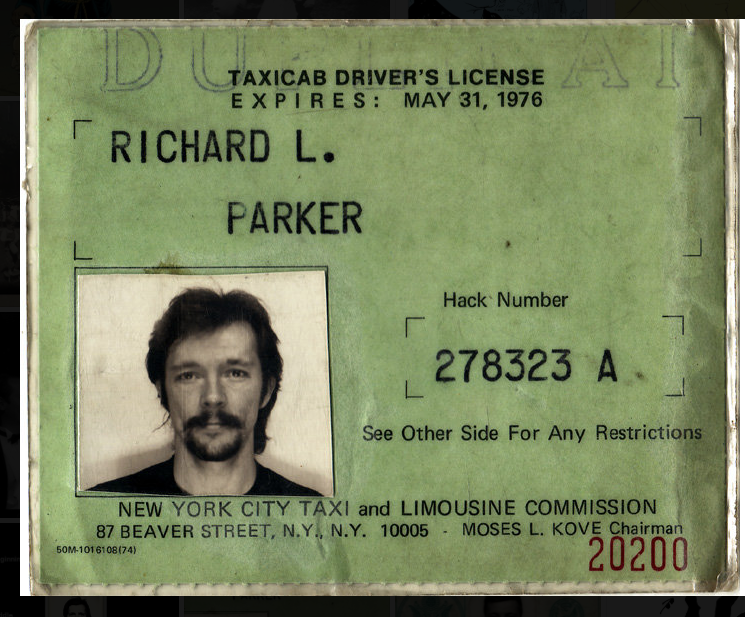
hack.license  The name of the company was CARRICK Service Corporation. I needed a job and according to the Help Wanted Section of the newspaper, they needed “DRIVERS“. I would be getting paid to drive a CAR and my name was RICK, so it all seemed to fit.

I got off the E Train at Queens Plaza and walked down the stairs to the cracked and broken sidewalk bordering a cyclone fence topped with barbed wire. It was three o’clock in the afternoon and in the dim light under the elevated, it was easy enough to avoid stepping on the broken wine bottles or tripping over various unidentifiable metal parts lost by passing trucks, which must have accumulated over several years in the gutter near the garage at 30-19 Northern Boulevard, Long Island City.

As I approached the one-story brick building a checker cab passed me, slowed down and made a left-hand turn into the parking lot. On the other side, nearest me, from an opening in the fence where there had once been a gate, a tired-looking man, perhaps in his late thirties, emerged and walked quickly past me without speaking, his eyes downcast, the color of his face a perfect match with the late afternoon shadows.

I entered the small brick building through a grey metal door into a room with a concrete floor. It reminded me of the locker room of the YMCA I had frequented in my distant childhood. There were five or six men sitting on benches against the wall and nobody looked up or smiled at me. On one side of the room there was a separate enclosed area with thick glass windows. The floor in that room seemed to be elevated slightly, so that its inhabitants could look down on the various men who were waiting, as a judge in a courtroom might look down from the bench on the accused in a criminal case.

I walked up to the window and poked my newly-acquired hack license through a small slot in the glass to the man behind the window. He held it in two meaty-looking hands and looked at it without looking up at me.

I looked at him. He was heavy, about fifty, and balding with close-cropped hair and deep set eyes. He was chomping on the butt of a cigar which which looked to be a permanent fixture in the corner of his mouth. He was wearing a light green short-sleeved shirt open at the collar. He had strong hairy arms. He reminded me a little of a rather gruff first sergeant I had known back when I was in the army. The man was apparently seated on a stool or some kind of high chair, but I couldn’t see him except from the chest up. There were a couple of other men behind the glass in the room with him who walked back and forth once or twice and seemed preoccupied with whatever they were engaged in. He put my license aside and through a small round hole in the thick glass he told me to, “Go sit down and I’ll call you.” 

I did as I was told.

As I took a seat on the bench, a taxi pulled up outside, the door opened, and a tired-looking man walked up to the window and handed the cigar-man a yellow sheet of paper. Then the guy went back outside and the door closed slowly behind him. I noticed that the cab was still there and the engine was running. A few seconds later, there was a sudden, loud and jarring, impatient-sounding announcement on the intercom from the man behind the window.

“SCHIFANO!!!” 

The guy next to me, got up off the bench and walked rapidly toward the window. He was carrying a Thermos bottle and had his dinner in a brown paper bag. The coins in his coin changer, which he wore on his belt, made a happy jingling sound as he walked, like the bells on Santa’s sleigh. The man behind the glass handed him his hack license and with his right hand, the Night Man put the Thermos bottle under his left arm, put the green hack license in his mouth, and with the hand with the bag in it, he threw open the door, got into his yellow cab with the engine running, which the “Day Man” had just brought in— and drove it back out into the city for his nine hour shift.

Impressing The Boss (Part The Last)

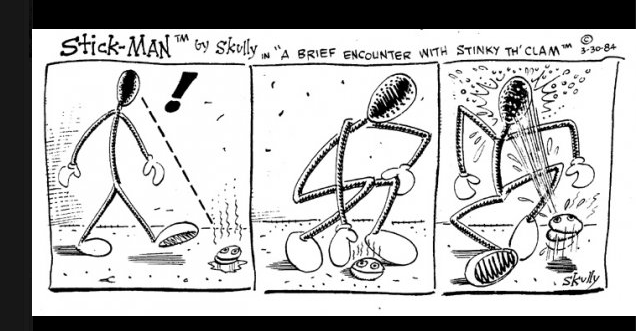
laying.rick104Stick-Man® had a brief life as my first original comics character. Before he ceased to exist, he had established himself in the subconscious minds of my co-workers at Marvel by his daily presence on the doors of the editorial offices and even made a Cosplay appearance at the Marvel Halloween Party. He made a cameo appearance in King Conan comic book and battled a similar character named Stick-Boy® (created by the California Cartoonist Dennis Worden) in a couple of issues of a fanzine called REAL FUN.

Stick-Man® submitted himself for syndication at King Features Syndicate and was turned down by the late editor-in-chief, Jay Kennedy, who expressed his reservations about whether or not a character who was mute and had no face would gain much traction with the American public. He had a good point. Body language and a tendency toward violence will only take you so far. Even with the addition of supporting characters like Stinky The Clam®, Professor McNutt, Mr. Happy, and The Human Spot, Stick-Man’s days seemed numbered. When last we saw him, he was standing on the boardwalk at Coney Island watching helplessly as his nemesis, Stinky The Clam, was being carried aloft by an unsuspecting pelican.

Stick-Man® did have one thing going for him: Stick-Man® was easy to draw. In fact, some people who went on to distinguish themselves as editors took pen in hand to produce their own versions of the character–namely Stan Lee and Jim Salicrup.

But not everyone loved him. Harvey Kurtzman took one look at Stick-Man® and changed the subject. But Stick-Man wasn’t done yet. He reached his greatest moment of glory in The 1984 Stick-Man Calendar (spiral bound and produced in a limited edition of 100). Among the highlights of his various adventures graphically depicted in the calendar, was falling in love with a parking meter and being honored by having himself turned into a Stick-Man balloon in the Macy’s Thanksgiving Day Parade.

After Stick-Man® came The Messengers and The Matchbook Drawings.

IMPRESSING THE BOSS (part three)

Screen shot 2014-10-15 at 10.22.28 AMOne Fall day in 1983, long after most people with actual lives to live had left the office and gone to the place they called home, I remained behind my drawing table in the Marvel Bullpen and began drawing stick figures. Six years earlier, as an art student at The University of Georgia, I was shocked–and somewhat taken aback– to learn from my very first art teacher at the University, who, by the way, had just returned from New York City that summer, that, “New York is dead”….” If New York was indeed “dead,” and since one, by rights, should listen to one’s college professors and take what they say seriously—and if New York was the center of the art world, it seemed to follow, by implication, that “art” was also dead. If art was dead, then painting and drawing were also dead–or at least very sick. Therefore, since I was in New York anyway, and, as an artist, for me to do my part to bring “art” back to “life”, I had to begin somewhere. Drawing stick figures on a sheet of paper seemed as good a place to start as any. Thus was born Stick-Man® by Skully. I felt much more comfortable using the alias, “Skully”, instead of my real name. That way, if the cartoon strip sucked, and the people I worked with didn’t like it, it was no reflection on me. Here’s how it worked: After most Marvel staffers had gone home for the day, I would draw a three or four panel Stick-Man® cartoon strip and then make a couple of dozen photocopies of it on the copier down the hall. Then I would tape them to the various office doors of my co-workers, who would read them the next morning. To my utter surprise and everlasting delight, most people LOVED them! Well, not everybody. One day, I happened to look up from behind my drawing table in the Marvel bullpen to discover that the editor-in-chief, himself, was standing outside an office door and he was reading my strip! He had his back turned to me and I watched him closely, trying to gauge his reaction. After ten seconds or so, he briefly shook his head as if trying to clear it of some bad thought. Then he abruptly turned to his right and began walking down the hall in the direction of his office. I jumped up from my seat and went after him. “What’s the matter, Jim….?, I asked. “Didn’t you like it….?”  He looked me straight in the eye. And then he said, “You KNOW I have NO sense of humor…” It was as if someone had hit me in the gut. His comment came straight out of the blue. “Oh… my… God”, I thought…. “….the Boss, the man in charge, the HEAD-Man at this company– has NO SENSE OF HUMOR????”  “What chance does a guy like ME have at a place like this….?”

Impressing The Boss (part two)

Screen shot 2014-10-14 at 8.30.02 PMBack when I first started working there, as is no doubt still the case today, there were a lot of talented artists going in and out the door at Marvel Comics–young artists as well as seasoned veterans– artists who looked like they had come back to work after fighting in the last war.

My first day on the job, I remember seeing a stack of penciled pages by an artist named John Buscema and another stack of pages with ink on them by some guy named Tom Palmer that really impressed me. There was a lady on staff by the name of Marie Severin, who could seemingly bat out, right before your eyes, full color originals to suit any occasion on a few moment’s notice. Just down the hall, sat a fellow they called John Romita, who was the artist of that Spider-Man comic the young man in the comics store had sold me, when, a couple of months earlier, I had ventured in and asked for an example of something “good” that Marvel had published.

I was surrounded by artists and writers who could make people fly, cause human figures of both sexes to tumble like acrobats across the page, create entire cities from scratch, and make visible fantastic alternate universes to anyone with 25 cents in his pocket.

Instead of being inspired by all this drawing ability and creativity, I found the whole situation rather intimidating.

I held those original comics pages which crossed my desk in my trembling hands and gazed at them in wonder. Week after week, month after month, for years, I stayed in my seat, did what I was asked to the best of my ability, and dutifully lettered captions and drew balloon after balloon around the dialogue.  I had no earthly idea how all those artists managed to do what they did. But, if I could, I was determined one day to join them.

Still scarred from my initial encounter in the Marvel Reception Room with Dan Adkins, a year or two earlier, I kept any latent drawing ability I had a secret. I was not about to suffer the indignity of having someone at the office tell me something I already knew: That my figure drawing was not up to par.

The main subject matter in art is people.To be a successful artist in comics in those days, you must be able to draw people realistically and convincingly– and they can’t just be standing around talking– you must be able to draw them in all situations–in dramatic and exciting poses. While there are a few exceptions, readers of comics, for the most part, want exciting stories, sequentially delineated with style and filled with pathos, something to engage them intellectually, or in a few cases distract them, if but for a short time, from the boring sameness of their otherwise mundane existence.

Since I couldn’t draw realistic muscular figures or even emaciated ones, and had only scant knowledge of anatomy, I wondered if perhaps I could do this with stick figures……

Impressing The Boss (part one)

Screen shot 2014-10-14 at 12.21.25 PM

Last weekend was the New York Comic Convention, and, once again, I didn’t go.

The past couple of years I was in Maine during the New York Comicon, so I had a good excuse for not going. This year, however, I was in New Jersey, not that far away, but I still didn’t go. I think it was more the psychological distance more than the physical distance that kept me away .

While it is always great to see old friends at this type of event, and to meet fans and others who profess to have enjoyed one thing or another that you have done, unlike in past years, I didn’t really have anything new to promote– and I would have felt a little silly, and perhaps even a tad embarrassed being there.

It would have been like showing up at a big party for a bunch of your friends and coworkers in your underwear, or not having a present, a card, or at least a bottle of wine.

Or a case of beer, or a cake, or something.

So I stayed home and cleaned out the garage and swept up the basement.

Truth be told, I had been working in New York City in the comics profession for a number of years before I ever attended one of those shows. I wasn’t exactly a big comics fan. In those days, the main focus of my interest was fine art. Years after working in comics, I still thought of myself as a “fine artist”. Although I continued to produce fine art and to get exhibited occasionally, and people seemed to like my work, I never made any money from my artwork, and so, comics, for me, became my default way of making a living.

I should also like to state for the record, that I had always liked to draw from the time I was a small child and some people thought I was good at it, but my interest in art evolved over the years from coloring books to cartoons, to portraits, to acrylics, to oil paint, to lithography, to collage, to bronze-casting, to photography, to performance art, to conceptual art.

By the time I got a job in comics, I had already received a bachelor’s degree in drawing and painting from the University of Georgia and a master’s degree in printmaking from Pratt Institute. I had worked for a year or so in a lithography shop in Manhattan producing lithographs for established artists and had begun showing what would become a 12-year series of hundreds of my three-dimentional artworks in the street-level window of my ground floor storefront studio in Lower Manhattan.

But, like most people reading this, I, too, needed money. The art dealers didn’t come looking for me until after I was no longer producing the type of work they were looking for.

My interest in comic art had been fomented mainly by having read the newspaper strips as a boy. I read EC and even spent my last dime on Uncle Scrooge comic books by Carl Barks– and later on, I devoured Mad Magazine. As a youth, sitting alone in the living room of my boyhood home, I poured over dozens of old issues of The New Yorker Magazine going all the way back to World War II, which had been saved by my parents . Richard Taylor’s cartoons held a strange fascination for me.

By the time I started going to the Marvel offices in search of freelance work in 1976, it was the age of the superheroes and judging by Dan Adkins’ reaction to my drawing portfolio, there must have been something very “unheroic” about my work.

I can’t really blame him, actually, because I seem to recall that one of the pieces in that portfolio depicted an ostrich astride a grave.

The big bird was struggling mightily to pull up a “worm” from a few feet in front of a granite monument with the name “PARKER” inscribed on it.

I’ll never forget the look on his face when he turned to that page.

Then he looked away— slowly handed my portfolio back to me— and with nary a word of encouraging advice, slowly stood up, walked across the floor– and disappeared back through the same door to the Marvel Reception Room through which he had emerged only a few minutes previously.

A couple of months later, more desperate for work than ever, I answered an ad in the Help Wanted section of The New York Times and was hired to do lettering corrections on staff at Marvel.

It was the age of the superheroes and having grown up reading “funnybooks”, I could not relate.

Reflections On a Windy Hillside

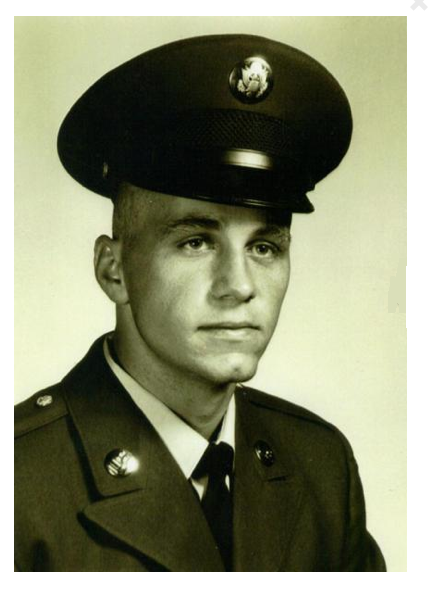
On 4 NOV 68 I was 22 years old and O.I.C. of the military funeral for PFC Robert C. Harkins, of New Boston, Texas.

He had been killed in action in VN before he turned 21.

My military detachment from Ft. Sill, Oklahoma, consisted of fifteen uniformed soldiers in dress greens. Six wearing white gloves to carry his flag-draped casket from the hearse to the grave, and a seven-man firing party carrying M-14s firing blanks to honor his sacrifice with three volleys of fire to comprise a 21-gun salute. There was an NCO to command the firing party so that their volleys were in unison, Sgt. Tom Conway of Tampa, Florida and one lone bugler, PFC Hampton (Lionel Hampton’s nephew) to blow taps as the American flag which had draped PFC Harkins’ casket was being folded. The bugler was strategically hidden behind a cypress tree off in the distance.

PFC Harkins’ next of kin was a five year old girl, his daughter, to whom the folded American flag was to be presented at graveside.
It was a sunny but brisk November morning and we were gathered together in a humble little cemetery on a bleak hillside overlooking a highway on the outskirts of Texarkana, Texas. As the ceremony began, I remember I noticed a truck, an 18-wheeler, speeding along in the distance, the moan of its diesel engine seemed to fit the occasion. As the white-gloved soldiers carrying the remains of PFC Harkins inside the silver casket reached the grave and set him down gently for the last time they lifted the flag and held it tight at waist level, while a Southern preacher drawled a soulful and brief prayer.

I thought it strange that the cars and trucks down on the highway did not stop, but continued on their way, oblivious to the scene that was unfolding before our eyes. It seemed to me that the whole world should stop.

The preacher concluded his remarks, closed his Bible with a dramatic thump and took one step back. This was the signal  to begin to fold the flag. My men, who had spent a week training for this day, very smartly folded the flag and then the Senior Pallbearer, Specialist Bennie K. Stephens of Little Rock, Arkansas, executed a left face took several steps forward and bent down with the American flag in his upturned and white-gloved hands. He spoke softly to the little girl who was seated nearest the freshly-dug grave of her father.

“Please… accept this flag…. on behalf of a grateful nation….”

For a brief moment, the little girl looked up at him as if unsure of what to do. Then she reluctantly took the flag and held it up against her chest as if trying to keep warm. It struck me as much the same way that her dead father must have surely held her when she was a baby only five years before.

The moment was shattered as the firing party fired the first volley of the 21-gun salute. It startled everyone, myself included. It drowned out the whir of the tires from the passing trucks far below. It drowned out the thoughts of the little girl and the few who were gathered there who had known PFC Harkins in life.

When the last volley of seven shots had rung out and echoed off down the hill past the roadway and the barbed wire fence beside it, SP4 Hampton began to slowly blow taps on his golden trumpet. And the few gathered there who had known Pfc Robert C. Harkins in life began to softly cry as the funeral director released a lever and began to slowly lower PFC Harkins into his own little corner of America.

Off in the distance, another truck whined down the highway. The wind picked up and I felt a shiver run through me. Suddenly, PFC Harkins’ daughter began to cry out, “Daddy….Daddy…Daddy…..

….she cried “Daddy” over and over again, as the top of his now bare silver casket descended forever from view.

I thought about how he would not be there for her next birthday party… or to tuck her into bed… or to read her a story. He would not be there to watch her in the school play or see her graduate from high school. She would have no father to give her hand in marriage–or for any of those things in life that we all live for.

I wondered what kind of memories she would have of her father that she might carry with her as she lived out her life.

That little girl would be 50 years old now.

I have often wondered what kind of guy PFC Harkins was. I wondered what his life was like, and where his wife was. I have thought about him many times over the past 45 years. Today for the first time, I saw his face.

I think it’s good to remember that there are many men and women like Robert C. Harkins who have served in our military and sacrificed their lives for our country.

We owe them all a debt of gratitude which we can never repay.

harkinsLet us never forget them.

You Are What You Draw


It was probably a Saturday afternoon in that summer just before I turned eleven when I spotted it.

It was laying on the sidewalk outside the Victory Soda Shoppe on Waters Avenue in Savannah, Georgia. No one but me was around that moment and no one had stepped on it yet.

It hadn’t been laying there long.

Someone, almost certainly a kid, had either dropped it accidentally or bought it for the large pink square of bubble gum that left its powdery presence behind on the card. The image was of a drawing of the back of a nice looking blonde girl or woman and she was walking down the street. The caption over her head at the top of the card said, “With a face like yours, you should be in movies–”


When I turned the card over, I was simultaneously shocked and delighted  to see another drawing of the same girl, but this time I got a clear view of her face.

It was misshapen and warty, she had a short, stubby turned-up nose and sunken eyes. Her mouth was distorted and open and just a hint of crooked green broken teeth through swollen purple lips. She was ugly.


Above the image of her face the card continued the message from its other side: “–HORROR Movies!”

I thought that was the coolest thing I had ever seen.

In the lower right hand corner there was a name, “Jack Davis”. I think that was the first time that I realized that there were actually people creating the pictures that I liked. I don’t remember seeing names in the corners of the pages of the Little Golden Books my grandmother had read me, when I first became enamored of colorful illustrations.

But there it was right there on that card. You couldn’t miss it: “JACK DAVIS”.

Clearly this was the work of a genius. Yes, these pictures I loved so much were being done by real people. I found out later those people were called artists”. I made up my mind that very instant that I wanted to be one of them when I grew up.

I did become an artist, but I never did grow up.

Not long after that, I rode my bike down Waters Avenue and crossed Victory Drive and went a couple of blocks to The Eagle Barber Shop for a haircut, as I had done every few weeks of my entire life since my mother had taken me there for my very first haircut when I was a very small child.

I always read comic books while waiting my turn for a haircut.

Meanwhile, Mr. Upchurch and Mr. Ulin snipped away with scissors at some man’s head or energetically cranked the big barber chair back for another man, leaving him flat on his back and covered up to his chin in a white sheet. They stropped their straight razors in preparation for shaving these men– and I read on.

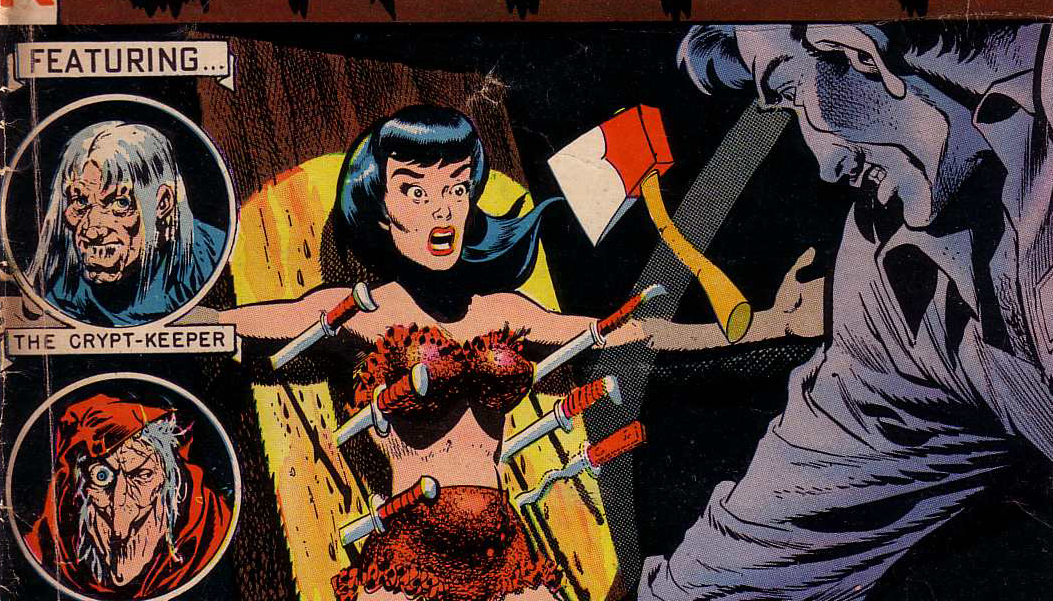
The comic I picked up to read had been read so many times by countless other boys that the cover had fallen off and the yellowish-brown pages were dog-eared and brittle. The first thing I noticed on the one I was reading was a man in a blue bathrobe. It was tied around his waist with a rope. It was the same kind of rope that they used to hang people. But what struck me about the man was that he had long silver hair hanging down to his shoulders.

It was 1953. None of the men I knew, not my father, or the fathers of other kids, nor people who worked in stores, not even men you passed on the street–none of them had hair like that.

I was fascinated by that man. I read the first balloon, anxious to see what he was saying. He introduced himself. He was The Crypt Keeper. I wasn’t sure what a crypt was, it didn’t sound like anything I wanted or needed, so as far as I was concerned he could keep it.

I read on, fascinated with what the man with the long silver hair had to tell me. He seemed to be looking at and speaking directly to me. I read on, feverishly–fervently hoping that I wouldn’t be interrupted by anything so mundane as having my hair cut.


When I got to the bottom of the first page, there was that name again: “JACK DAVIS”.


A few years later, when I first began reading Mad Magazine, I saw that name again. I was already a JACK DAVIS fan, but when someone at school told me he was from Georgia, my home state, that cemented my determination to follow in his footsteps. I didn’t realize at the time how large those footsteps were.


Fast forward fifty years.


I’m sitting at home petting the dog and drawing when the phone rings.


It’s my old friend Jim Salicrup, former editor of Spider-Man at Marvel Comics where I had worked for about twenty years. He had recently become editor-in-chief of a new publishing company in New York called Papercutz. They were bringing back Tales From The Crypt, featuring my old friend The Crypt Keeper.

Jim wanted to know if I would like to be the artist of The Introductory Pages, which featured the man with the long silver hair, his cohort, The Vault Keeper, and their associate in a droopy red hat, The Old Witch.


Of course I said “Yes”. Who wouldn’t? I hadn’t worked in comics professionally for nearly ten years and was thrilled at the opportunity to draw that character which was so memorable to me as a child.

Jim wrote the stories and I drew them until the scripts finally stopped coming a couple of years later. It seems the fans of the original series didn’t like the new approach which had the Crypt Keeper working on his laptop or talking on a cell phone. And the current generation of kids, who were the target audience, had no idea who these weird characters were.

So the series morphed into The Papercutz Slices series of parody books.

And I kept drawing.

Overall, it was a great thrill for me and a great honor to follow in the giant footsteps of my idol, Jack Davis. To be a tiny part of the history of those artists who have drawn “The Ghoulunatics” was one of the highlights of my career.

Although I drew the characters hundreds of times, I never came close to imbuing those three characters with the same energy and style that Jack Davis had.

But God knows I tried.

While I was working on the series, I used to notice an old man walking past my house several times each day. He was an odd, hermit-like fellow who bore a strange resemblance to The Vault Keeper in those stories I was drawing.


I became friendly with the old man and we often chatted. He seemed to be stuck in time somewhere way back in the distant past and his observations and remarks about the world he knew, though harmless, clearly set him apart from me and the rest of society. But I liked him anyway.

One day I asked him if I could have my photo taken with him. (I didn’t want to tell him it was because I thought he looked like the Vault Keeper, but I confess, that was partially why I wanted a picture of him).


I stood next to him and my wife took our picture together. In the resulting photograph he looked just like the Vault Keeper, just as I knew he would. What was even MORE surprising is that, to my horror,davis I looked exactly like The Crypt Keeper.


Now I’ll bet Jack Davis could never do that.