All posts by richardlowellparker

Rick Parker is an American artist, cartoonist, and humor writer well known in the comics world as the artist of MTV's Beavis and Butt-Head Comic Book (published by Marvel Entertainment 1994-1996). He is also the writer and artist of the self-published graphic novel, "Deadboy", as well as being the illustrator of the Papercutz Slices parody series of graphic novels, "Diary of a Stinky Dead Kid", "Harry Potty and the Deathly Boring", "breaking down", (a Twilight parody), "Percy Jerkson and the Ovolactovegetarians", "The Hunger Pains", and "The Farting Dead". Rick Parker was one of the four artists of The Pekar Project, which brought new original illustrated stories of autobiographical comics pioneer, Harvey Pekar to the web in 2009-2010. His graphic novel, "DRAFTED" about his time in the Army during the Vietnam War will be published Abrams Comicarts in the near future. Rick Parker resides in Maine with his family where he draws cartoons, teaches cartooning and writes this blog.

Street Boss

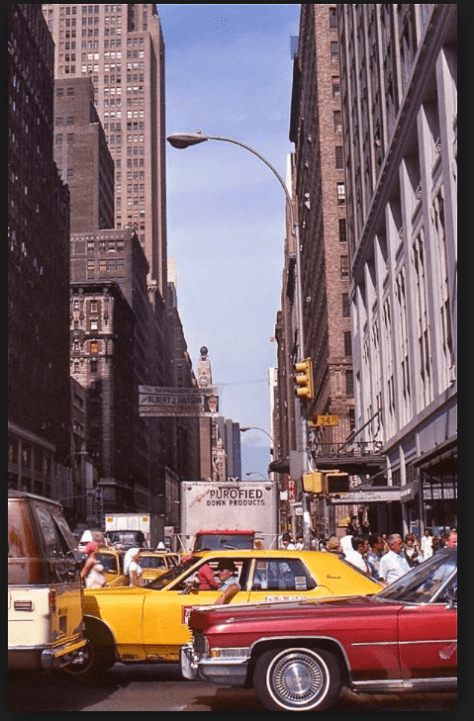
screen-shot-2016-09-14-at-11-19-39-amIt was a cool, crisp, late Fall afternoon in The City in 1976 and I had been driving a cab at night through the mean streets for about a year.

I had always liked to drive and considered myself quite good at it. When you drive the same car an average of 125 miles each night, night after night, through the streets of New York for a year, it becomes an extention of your body. I had a good body then. I was 29, six feet tall, I weighed about 165 pounds and I didn’t take any shit from other men.

I was armed with an aluminum lunch box with a turkey sandwich with sprouts in a plastic bag and on the front seat next to me I carried a green apple wrapped like a hand-grenade in a paper towel that Shirley, my girlfriend at the time, had packed for me. Next to my lunch was my old wooden cigar box with a five-dollar bill and eight ones. Hanging on a steel strap next to the taximeter was my metal coin changer. It would make a decent substitute for a pair of brass knuckles should I need to defend myself against an attacker, although I would imagine that the impact against his grizzled face would have cost me a few lost quarters if not a few dimes and nickels. On my size 13 feet, I still wore my old black combat boots which had been the only things I had taken with me when I got out of the army several years before,  other than a few vague notions of what my life as an artist might be like after I moved to New York.  Back then, I never imagined myself as a cab driver.

Sixty-ninth Street between Central Park and Columbus is a one way street running West. And there are always parked cars lining both sides of the street. At times, there are even cars double-parked on both sides of the street– leaving only enough room for one car to squeeze through. I prided myself on my skill behind the wheel. I could run the gauntlet across Sixty-ninth street at 30 miles an hour with inches to spare on either side. Passengers would sometimes comment or, more often I would glance in the rear-view mirror to see them cowering on the back seat of my cab with their teeth clenched and their eyes squeezed tightly shut. Once I even thought I heard a man praying.

That was then.

But now, I was in Lower Manhattan in the 20’s driving up the center lane of Third Avenue in search of a fare. There were cars and other cabs on either side of me and we were hurtling uptown in a yellow wave at thirty or thirty-five, timing it so as to catch all the green lights as we went. As I drove right up to the edge of recklessness, my eyes scanned either side of the Avenue and I positioned my taxicab so as to be the first one to be able to pull over to the left or the right should anyone be foolish enough to step out into the street from between parked cars to hail me.

Blowing past Twenty-third Street at forty miles an hour, I was in the lead of a group of cabs all jockeying for position. Block after block rushed by in a blur by as we all raced foward in search of a fare. Suddenly I noticed one of the cars speeding along in competition with me to my right. To my surprise, it wasn’t a Checker or a yellow cab or even a gypsy cab. It was a little maroon-colored car.

What kind of idiot drives a little maroon-colored car at forty-five miles per hour on a busy city street?

Whatever kind of idiot does, was behind the wheel and seemed to be in a big hurry to get wherever he was going and I watched in annoyance as he weaved in and out of traffic and kept pace with me. The nerve. I’d show that maroon who was the boss of the streets.

And so, I forgot all about fares and picking up people and making money.

Someone should let that moron in the maroon car know that it was dangerous to drive that way in New York City.

I decided that person should be me.

I quickly angled my taxicab over to the right with the intention of pulling up next to them and giving them some nice, friendly, helpful advice.

New Yorkers should help each other.

Instead, they sped up, so I sped up– and suddenly we were shooting uptown passing a few people who tried to hail me. I was rapidly approaching the edge of my comfort zone, so I made the determination that the best course of action would be to force the offending driver to come to a stop.

I pulled right along side of them and the driver looked at me. He actually looked surprised to see me, but kept driving. He was in the right hand lane and there were cars parked all along Third Avenue. I stayed parallel to him blocking him from changing lanes so that eventually he was forced to come to a dead stop when he came to a bus that was picking up passengers in the right hand lane.

I pulled up a little ahead of him, stopped my taxicab and got out.

As I walked back toward his car, I could see that there were two men in the car. I walked over to the driver’s window and offered the man behind the wheel the following helpful advice: “If you want to kill yourself, get a gun.”

The passenger door of the little maroon-colored car opened and the passenger got out and approached me.

He was a large man of Asian descent. He reminded me vaguely of a villain in a James Bond movie I had seen once, years earlier. He was about four or five inches taller than I was and outweighed me by about fifty pounds. Suddenly I felt very small and very stupid. He addressed me:

“You got a gun, cab driver…?” 

I tried to think of something tough and clever to say but I drew a blank. Besides, it didn’t seem like the kind of question where the asker expected an answer. It was more of a rhetorical question. So I just stood there, staring into his thick hooded eyes, and trying not to pee in my pants.

After a few more seconds, he said, “Get back into your cab and drive, taxi driver.”

Seemed like good advice to me.

And very helpful.


Weirdos, Zombies, Gangsters and Captain Kangaroo

captain-kangaroo


A few years ago, after sixty years of drawing pictures, and after moving to Maine, and faced with the reality of not having much paying work and with the children almost grown and the two of them becoming increasingly independent, and for wont of nothing better to do, I decided to finally confront an old nemesis I had been unconscioiusly carrying with me all these years.

Fear of drawing the human figure.

One nice thing about the graphic arts is that it is not like the performing arts. No one ever need see the artist’s mistakes, and in fact, in selecting examples of my work from the last three years for my recent exhibit, I burned many things I came across in my archives which for one reason or another displeased me, and I would not want anyone to see them as examples of my work.

I should say that I have never been one of those artists who feels that he has to have an idea in mind before starting to work. I think I have more in common with an explorer who sets sail for an unknown and faraway island with neither map nor compass to guide him. Confident that even though my small boat may spring a leak– or take on water– it will not sink. That I will sail on with my invisible crew, completely lost in the joy of sailing and somehow, every single time, I arrive at some beautiful destination, as if by magic, almost as if someone else had been piloting my vessel and I a mere stowaway.

So it was that with infinite vague images of humans in my head to guide me and with a seemingly endless supply of paper at hand, I sat down at my old wooden drawing table in the corner by the window and bravely touched the tip of my pencil to the nice smoothe surface of a fresh sheet of blank paper.

Several thousand drawings and a few years later I was beginning to understand how the skin stretched tight over a shoulder blade curved into a muscle in the back and how the bony structure of the skull underneath the eye socket can gradually over time become the sunken hollow of a once-youthful and oft-kissed cheek. Or how the calf muscle on the lower leg is slightly higher on the inside if you’re looking at the figure from the front and how the ankle bone is higher on the inside of the leg than it is on the the outside of the leg. In fact, the structure of the human body really does make a lot of sense from a practical point of view in addition to its incredible sensual beauty.

There are many good books on human anatomy and figure drawing and even more bad ones. But I am the type of artist who prefers to search for things hidden in darkness rather than placed in plain sight in sunlight. The mind fills in more interesting answers than the obvious ones.

So with an empty house at my disposal and a desire to see some of my recent efforts on the wall and anxious to share my new-found drawing skills with a new set of friends and a few old ones, I proceeded to buy up every cheap plastic frame that Walmart® could supply.

Going through thousands of drawings and trying to decide what to include in an exhibition like mine was easy. I chose drawings I’d done which I liked and burned others I didn’t. One hundred and seventy-five drawings was just the tip of the iceberg and I later discovered hundreds of others that could easily have been included had I had a bigger space for an exhibit.

Then came the embarrassing task of publicizing the event. And the agonizing task of who to invite and who not to invite. Would the nice old couple I spoke to every day who walked their dog past our house each evening really want to focus their gaze on a rotting zombie with an upraised butcher knife? “They’re my generation,” I thought.

What the Hell.

So I invited them.

What about some of my artist friends newly-acquired in recent years from Portland? Of course, it goes without saying. I invited as many as I thought might like the show. One man, a comics-fan who has bought work from me in the past and paid me for other work which I have yet to complete, came to my show. It was also around my birthday so he came bearing gifts and never asked how that piece I promised to do for him was coming along.

I need more friends like him.

Here is a partial list of people who I wish could have come to my art exhibit on the 27th:
1. My grandmother with whom I lived for the first 16 years of my life. And the last 16 years of hers. She, more than anyone, instilled in me at an early age a love of stories with pictures.
2. My parents and other family members who have passed away. My mother once told me my work was “ugly” and she was right. But it was ugly in a beautiful way.

3. My biological father whom I never knew existed until last April. From what I have gathered, he liked taking photographs and writing stories. I think he would have been amused.

4. Larry Shell who loves comics and comics people and lives in NJ and no longer drives, but has been a great friend for almost two years now.

5. My editor at Papercutz, Jim Salicrup who is busier than a one-legged man in a butt-kicking contest. Jim has been a very supportive and loyal friend.

6. Mike Judge, who is the only person I ever met who didn’t like Beavis and Butt-Head Comic Book, but is cool anyway.

7. My old boss, the late Danny Crespi who gave me the only real job I ever had.

8. Vladimir Salamun, a friend of forty years and the best man at our wedding who I haven’t heard from in about a year despite repeated attempts to reach him. (I called him after I wrote this and we had a nice chat.)

9. My Pal Philip Felix, former Kurtzman assistant and letterer who doesn’t like to drive long distances.

10. The late great writer/editor, Archie Goodwin who came to see my art exhibit in 1980 and told me that people don’t like funny fine art.

11. Yukie Ohta who grew up in the neighborhood in Manhattan where I exhibited my work to the public for 12 years and was nice enough to include me in her efforts to preserve the Memory of the neighborhood when it was an arts community.

12. Art Dealer Barbara Toll, who gave me my first show in New York and told my ex, “He has a great mind.” My ex wasn’t interested in me for my mind.

13. Martha Wilson, of Franklin Furnace, a woman with a vision and an artist with a following.

14. Kyle Baker, the greatest cartoonist in the world and most creative person I know in comics.

15. My Buddy Jack Morelli, former Marvel Bullpenner with great creative talent and father of two and husband of one and friend to many.

16. Joey Cavalieri, who took an interest in my early work and encouraged me to give comics a try.
17. Herb Trimpe, who liked to draw and fly open cockpit airplanes. He died earlier this year. Of natural causes.

18. Mark Chiarello who lives in California and likes it.

19. Harvey Kurtzman who looked at my cartooning in 1982 and smiled sweetly but said nothing.

20. Jack Davis who was a huge inspiration to me as a young artist and only died a month or so ago.

21. Nina, our maid, who, when I was a kid, told my parents, “Ricky’s going to be an artist when he grows up.”
22. Jack and Irene Menotti, two old people who lived in the same building as The Barking Dog Studio in New York City. I would love to know what they were thinking when they looked at my artwork in those days. I should have asked them.
23. Joe and Jewel Brooks, two old people who rented a room to me for a dollar a day when I was in the army and took me with them to church every Sunday, after making me breakfast and treating me like the son they never had.

24. Paul Trusiani, my father-in-law and a real humanitarian, who died last year and who was never anything less than a great person in all circumstances.

25. My two biological siblings that passed away many years ago at 50.

26. My first cousins, Kathryn Braswell Hochman and her sister, Becky Braswell Botts who live way down in Dixieland.

27. My childhood friends, Allen Joyce and his brother Jim Joyce.

28. My old Buddy, Ray Anderson, who used to give me a ride to summer school in his Model A Ford and introduced me to my first girfriend.
And last and by no means least, all my old friends at Marvel who put up with me.

And yes, you, too.

You know who you are.


Dear Father I Never Knew I Had

BRASSWELL.train


I don’t really know how to address you, since we never actually knew each other in life, although I am quite sure you knew I existed.

It was a small world back then.

Just to fill you in on a little of what you missed, let me start by saying I had a pretty good childhood. As you know, I grew up in Savannah and after my Dad sold the house I was conceived in, we eventually moved back to Savannah and lived with my grandmother. You remember her, I’m sure. I read in my Dad’s diary recently that she invited you and your family there for dinner on at least one occassion. She made a great lemon meringue pie. I hope you got a piece.

I played little-league baseball and once bunted my way onto first. I was a fast runner. When my Dad came home unexpectedly one night and found you in bed with my mother, did you run?

I played football, too, when I was about nine and we had a dog named Muffet. She was half Pekinese and half Chow and had a curly tail. Did you like dogs?

Ours got run over when I was in school one day and by the time I got home my Dad had buried it under an old Magnolia tree next to the house. The bloodstains on the street out front were there for weeks, though. I can’t help but wonder how you would have handled that situation.

I liked to draw pictures and was known in school as the kid who could draw. Were you good in art?  I know you liked to write, I’ve read some of the history of your family which you wrote. Just curious. Am I mentioned in there? If I read between the lines, might I discover even the slightest hint of my existence?

Did you ever once dream about me?

After graduation from high school, I went to the local college and flunked out in short order. I was terrible in Math. Did I inherit that from you? It’s probably a good thing that you didn’t know about that, otherwise you might have been embarrassed. I know I was.

Anyway, as a result, I got drafted into the army during the Vietnam War when I was just nineteen, but they didn’t send me over there to fight, thank God. I’m really not a fighter. Unless I have to, in which case I’ll rip the person’s throat out.  I’m glad you didn’t have to concern yourself with that, I know my mother worried about me enough for everyone– and anyway, after three years and a couple of close calls, I got out of the army and went back to college on the G.I. Bill and studied art.

If I had known about you when I was young, it would have no doubt have caused a lot of problems, maybe even messed me up psychologically, so thanks for keeping a low profile and keeping your distance.

Recently, I looked at some pictures of you and your family in the old days. You all seemed pretty happy.

I have to ask you something.

Were you the guy who was rude to my father in the office building that day when I was about 13? My father went to see you about something and took me in with him. I remember you didn’t want anything to do with us. So it couldn’t have been work-related. It had to have been something personal. And that’s just the kind of thing my Dad would have done, too. That picture I saw of you online from that time period sure looks like that guy. If it was you, I’m glad that at least you saw me that once. People should get to at least see their children, even if they don’t want to have anything to do with them. It’s okay that you acted that way. Believe me, I’ve been in some awkward situations in my life, so I can totally relate.

I hope I’m not boring you.

After college, I moved to New York City to attend graduate school and be an artist. I had some pretty interesting experiences there. I worked as an artist’s lithographer and assembled designer furniture in an old building underneath the Brooklyn Bridge. I even drove a taxicab for a year or two. Did you ever go to New York City in the 70’s and ride in a cab? Wouldn’t it have been a strange if I had picked you up? That would have been a Hoot!

I know you liked art, because I saw a photo of you examining some photographs from an exhibit you were in. I liked taking photographs too, and won several photo contests run by a New York newspaper. I’ll bet you would have been proud of me. I even had my own art museum, too, where my three-dimensional art was viewable to the public for 12 years. Over the years, thousands of people must have seen it. I wonder if, by chance, you were one of them. Stranger things have happened. I’m sure you would have to agree with me on that account!

To make money, I worked in the comic book business for about twenty years. Did you read the comic strips when you were a kid? I know in the 1920’s when you were a boy, there were some great comic strips in the newspaper. I’m sure you read them. Everybody read comics in those days. Did you like Krazy Kat? You seem like the kind of guy who would have liked Krazy Kat.

You were a little crazy, too, from what I have gathered.

I’ve been married twice, if you must know.

My first wife died not too long ago. We weren’t a very good match.

If I may say so, you and your wife must not have been a very good match either, or I wouldn’t be here–so we have that in common.

Sometimes in life, if you’re lucky, you get a second chance. I guess I’m lucky because I’ve been married to the same woman now for almost 23 years and we have two fine boys. You would have liked them. But I know you had a bunch of grandchildren and I’m sure you enjoyed them. I told my sons about you already, and I hope this doesn’t sound rude, but they weren’t all that interested. You know how kids are.

Well, that’s all for now. I’ll probably write again after I’ve had a little more time to sort all this out.

Oh–!  Before I go, I do want to say that I am really enjoying having your two nieces as first cousins. And my uncle, Gene, whom I unfortunately never met, seemed like a great guy, too. Did you ever tell him about me? Sure you did. He was your brother. Brothers confide in one another. I wish I could have known mine. Joe looks like such a great guy in the pictures.

Oh well, I guess I can’t complain too much. I’m here, after all, and that’s what counts. Wouldn’t you agree?

And for that, at least in part, I have you to thank.

And so, for what it’s worth—Happy Father’s Day!


And I Swore I’d Never Live in New Jersey

Screen Shot 2016-04-08 at 8.26.02 AM

Today we finished emptying out our home of the last 18 years.

It was the home our children grew up in. The home they left every day to go to school. And the home they came back to every afternoon.

It was an old home. We weren’t its first occupants.

When we were new there, in an upstairs bedroom, my wife rocked the little one to sleep and sang to him every night. He was just one when we moved there. It was the home where the kids had their friends over and we had their birthday parties and they played in the log cabin in the back yard near the rabbit and the two turtles who lived in an old washtub. The boys grew bigger and soon swang in the swings and slid down the slide. Our bulldog, Gertie, is buried in that yard.

The tooth fairy left money under the boys’ pillows and they tiptoed down the stairs on many a Christmas morning to see what Santa had brought them.

We had our friends over and we sat on the big front porch and ate pizza. It was a good old home. We loved living there. But time passes and things change and kids go away to college and there comes a time.

The time came.

It was a hard home to move from. It took us a few years to finally get all our things out and today I removed the last article. It was a little red plastic monkey with a hooked arm that had somehow found its way to the basement and I found it when I was sweeping up. I wiped the dust off it and hung it up in the rafters in the basement where no one will ever find it.

The last day we were there an old friend drove by and pulled over to say goodbye. It seemed fitting in a way that he was the last person to visit us there since he and his wife had been the only people in town we knew from New York and they moved to our little town just after we did.

Over the years we met many great people in New Jersey. Sometimes New Jersey gets a bad rap, but we really had some great times there.

At the end of a long day of packing and when the last box of old comics was safely stored in the back of our car, I noticed it was still unopened from that day over twenty years ago when the guy in the mailroom at Marvel sent it to me. I always knew that one day, I would get around to reading all those comic books.

But first, I had some other things I wanted to do.

But now I think the time has just about come to open that box.

The Man Jack


When the Old Brewery at The Five Points was demolished, its reputation as the most squalid tenement in New York was assumed by Gotham Court, sometimes known as Sweeney’s Shambles, at Nos. 36 and 38 Cherry Street, although the claims of this fearsome pile were disputed by The Arch Block, which ran from Thompson to Sullivan Streets between Broome and Grand. Among others the block contained the famous dive kept by a giant Negro woman known variously as Big Sue or The Turtle. She weighed more than 350 pounds and was described by a contemporary journalist as resembling a huge black turtle standing on its hind legs.” ( from Gangs of New York by Herbert Asbury).


In 1975, my first art studio in Manhattan was just steps away from The Arch Block at 46 Grand Street, between Thompson and West Broadway. The run-down tenements and small brick buildings of the Arch Block had long been demolished, and by the early 1920’s, they had all been replaced by a large industrial building which stands its ground to this very day.


But it was in one of those darkened back rooms of the Arch Block, on Thursday, October 1, 1891, that The Baby Jack was born.

It’s even possible that Jack’s father stopped into Big Sue’s on the corner to have a two-cent beer to celebrate his young son’s birth, as he had no doubt done too many times before, although this time, he may have considered the blessed event as “just another mouth to feed”.

About a third of the children born on the Arch block died as babies, so regardless of what their fathers thought about them, they did not have to feed their mouths for long.


Not so with The Man Jack.

Even when Jack’s father was dragging him to prize fights in New York as a boy, and leaving him  sitting next to an empty chair in the audience for five or ten minutes, watching with wide eyes as his father climbed into the ring to win a few dollars by going toe-to-toe with some palooka to warm up the crowd before the Young Stibling fight, or some other bout, his father could never have guessed that his young son’s mouth would need to be fed that day– and every day forward– for over a hundred years.


At the turn of the century, at the foot of the Sixth Avenue El, on the Northwest Corner of Grand and West Broadway, The Man Jack was just The Boy Jack, then, an eight-year old kid selling The New York World and The Journal American to black-hatted men in heavy coats, who smoked cigars and flipped him two cents for his trouble. The Boy Jack often watched as Teddy Roosevelt, then Police Commissioner of New York, walked past him and down Grand Street to visit his friend who had a drugstore on the Northeast Corner of Grand and Thompson.


The Young Man Jack grew up loving horses and when he was old enough, he drove a wagon and two horses. In one of his heavy coat’s pockets were sugar cubes and he kept a few apples for his horses and one or two for himself in another coat pocket. He had an iron hook in his fist, its curved steel shank stuck out between his middle and index fingers and he’d quickly and deliberately sink it into large wooden cases or bales of cloth or other dry goods, with a pleasing CLUNK or THUK and leverage 600 pound bundles on and off his wagon using just that hook and his five-foot three and a half inches and 145 pounds of bone and muscle.


He and his horses and his wagon with its big wooden spoked wheels bumped along cobblestone streets dodging street cars and ladies in long skirts, all the way from the docks on the Hudson River to the garment factories in Lower Manhattan in the days before the Triangle Shirt Waist Fire.


One Winter day, around 1910 or 11, when Young Man Jack was around nineteen or twenty years old, he was sitting in his wagon waiting to make a pickup on the docks near Desbrosses Street when a brash, ill-advised “Irishman” driving his own team of four horses pulled in and got a little too close for comfort. It could have been a cold winter day and perhaps The Irishman kept a clear glass pint whiskey bottle in his inside coat pocket for himself instead of apples.

Young Man Jack called out to the Irishman,

“Hey—you almost ran over my horses’ hooves….”


Although Young Man Jack stood but five foot three and a half inches, The Irishman sized-up Young Man Jack incorrectly when he told him to,

“Shut your mouth– or I’ll get down off this wagon… and shut it for you.”

As I stood there listening to Old Man Jack, it was again a cold winter morning, about 70 years after the event actually happened.

In all likelihood, the man Young Man Jack had faced that morning–The Irishmannever spoke of that day to anyone. And didn’t like to think about it either.


As we stood face-to-face and Old Man Jack told me the story, out on the sidewalk in front of my studio, just down from where The Boy Jack had sold newspapers 80 years earlier, just outside our old apartment building on Grand Street, the same tiny one-bedroom apartment where he and his wife had lived since 1932, the one without a tub or shower, where they raised their daughter, the same daughter who came by car from New Jersey with her nice, insurance man husband on Sunday mornings and took them first to church, and then out to dinner afterward for years, then brought them back home in the late afternoon, Old Man Jack quickly dropped down into a slight crouch, his old knees, the very ones he had prayed on for years in the Church of St. Alphonsus, slightly bent.


I was young and he was old, but I confess to being a little intimidated by him as he faced me, his short, but trim 88-year-old body now assumed its fighting stance.

His gnarled hands once again formed themselves into bare fists. In the blink of an eye, he was Young Man Jack again.

It was a magical transformation.

Even more startling to me was that suddenly, I had been unwittingly cast into the role of The Irishman.

He started his story.

His body bobbed and weaved as his words brushed past my left ear.

“As I climbed down off my wagon, he took a swing at me and missed….” Jack ducked slightly to avoid The Irishman’s blow as he spoke.


“You didn’t even give me a chance to take off my coat”, Jack protested to The Irishman.


Old Man Jack, elbows bent, fists at the ready, head cocked slightly to the side, a wary look in his old grey eyes, shifted his 138-pound frame back on its heels slightly and gave a barely perceptible twist to his left, as he now told me how,

“He came at me again– and missed with a left hook– and as he went by, I dropped him with my right…..”

The Irishman, who was still wearing his winter coat, struggled to his knees in the snow.

And then he slowly looked up at Jack through his one bloody eye.


“I’ve had enough…” was all he had to say.


No doubt The Irishman’s team of horses, who had been watching the whole thing from a few yards away, and saw him fall, exhaled a mocking cloud of steam, indicating that, though they were but beasts, they too, had lost all respect for The Irishman.


Young Man Jack looked down at The Irishman on his knees in the snow.

And then Young Man Jack gave him some good advice, which I am quite sure The Irishman remembered until his dying day.


“Don’t ever mess with a little guy.”

After My Mother Died…


…. suddenly about ten years ago at age 86, I was going through the contents of the house prior to selling it when I came across an old wooden box containing some letters.

These letters had been stored away in the attic a half-century before by my father, who had, himself died, about five years previously, at age 94.


I grew up in that house, and when I was a boy, I used to go up to the attic, especially on rainy days. I liked the sound that the rain made on the tin roof. It gave me a safe, secure feeling to sit there, all alone, amid the old trunks and suitcases and rocking chairs and lamps that didn’t work, perfectly dry, as the thunder and lightning raged outside, and the rain beat down on the metal shingles just a foot or two over my little dry head.


When I was a child, I remember seeing that box. It was old and wooden and said “UNDERWOOD” on its side in big black letters. It was very heavy. I always assumed it had an old typewriter in it, so I left it alone. Anyway, it was nailed shut.


My mother’s mother had had the house built seventy-five years earlier, using the $5,000 insurance money she had received when her own husband had died suddenly at age 39. My mother had lived in that house since she was ten years old and she and my father had lived there as a married couple for over fifty years. Apparently the box had been nailed shut for most of that time. But now my grandmother, and then my father, followed by my mother, were all gone and I was fifty-three and I was going to sell that house.

The time had come to clean out the house and open that old box.


Instead of an old typewriter, the box contained books and letters and photographs of beaming young women whose frozen photographic smiles  remained hidden for fifty years. The box held my father’s personal diaries going back to 1934.

It was nice to see what an active social life my father had led prior to marrying my mother. From the letters and photographs in that box, it would seem he had been quite popular with the ladies.


I picked up one of the letters. It was robin’s egg blue and addressed to my father in Florida. It was mailed Special Delivery from Savannah, Georgia and dated about seven years or so after their wedding day. It was in my mother’s distinctive handwriting. She was several months pregnant with me when she wrote it. She began “Dear Bill”…..


After telling him where she was and where she had been staying since arriving back in Savannah, and that she had been locked out and that she had a flat tire on the car, she said she had visited his old friend and roommate, the doctor, who had examined her and found her to be a “healthy young woman,” and asked her to convey his “Congratulations”.

In the doctor’s opinion there was a “four out of five chance the baby was his,” and anyway, abortion was illegal and “he couldn’t tell my mother how many hundred women had come to him following their illegal abortions and had to have operation after operation, removing various organs, until they were left just a “hunk of meat” unquote.

My mother wrote to my father that he could believe that information if he wanted to, and wanted to know, based on that information, whether or not he wanted her to come back. She wrote that she had no intention of being made into a “cripple” or of living life “unwanted”. She said she would rather be dead and would “do something” if he would not take her back.


I was an only child and my parents had been married for eight plus years by the time I was born. My mother had been nineteen years old at the time she and my father were married and he 32. It seems reasonable that they would have had hundreds of opportunities to engage in certain activities which could conceivably result in the birth of a baby or babies years before I came along.

But I was their first, their last and their only.


It’s true that my father had told me once when I was a boy that he had been sick with Undulent Fever when he was a young man but I never connected this admission with his ability to father a child. He told me that he had gotten Undulent Fever from drinking raw milk in a milkshake as we happened to drive past the place where it supposedly happened.

The only effect this had on me was to make me wary of unpasteurized milk, which was of no concern to me whatsoever since we didn’t live on a farm.


Not long after discovering the letter I attended a family event at which my deceased mother’s older sister was present. Sitting next to my 90-year old aunt, I told her about the letter and asked her if she thought it possible that my father wasn’t really my father. “Oh, we all knew that Bill was sterile!”, was her response. Not wanting to believe this, I thought to myself, “…surely she is in the process of losing her mind”. 


One of the problems of getting older is, with each passing year, there are fewer and fewer people around who can answer questions about things that may have happened many years before. There is genetic testing available that could determine with a large degree of certainty whether or not my father was really my father or whether he was merely a man who I called my father, who acted like my father, and who most people assumed was my father.


Even though he did take my mother back and there are photographs of my father and mother with me– and my father looks happy, now after all these years, I still can’t help but wonder whether when he looked at me as I was a baby, or as I was growing up, or ten thousand other times– and whether or not he wondered if I was his biological child, or someone else’s.


I have to admit I never thought I looked very much like him.  And if pressed to do so, I would not describe my parents’ relationship as especially affectionate toward one another.

There always seemed to be some tension.

I put it down to my father’s stubbornness and the age difference between the two of them. I’ll admit to having felt loved as a child and my father and mother were nice enough to me– and my father never said anything particularly unkind concerning my lineage, but he was a different person when my mother wasn’t around. When he was around her, he was a more reserved person, almost as if being his true self would land him in some sort of hot water.

On trips to visit his mother and his sister and nieces he seemed a much happier person.

Was he my father? What is the truth? Does it really matter? What does it mean to be someone’s father? Did he love me any less if he had doubts that I was his biological child? How did that affect me and my own development? When he looked at me, did he see reflections of himself or someone else?


One thing I do know for sure, whether or not my father really was my father, or not, because my mother became pregnant with me, and they stayed together, he got a chance to be someone’s father.

And being someone’s father– or someone’s mother—for that matter, is one of the greatest joys in life.


Al


Screen Shot 2016-02-10 at 3.14.34 PM

I never knew what Al’s last name was — or where, exactly, that he lived.


It had to have been somewhere in my neighborhood, though, but not on my block, where I knew all the first and last names of every kid within five years of my own age on both sides of the street.


The same was true of the surrounding blocks North and South and West, but not East, (because of a busy street), where I had a comfortable working knowledge of most of the kids who lived in the modest houses up and down those blocks, as well as a few of their brothers and sisters.


No, the place where Al lived had to have been several blocks away, out in the mysterious districts outside my own little world, where the names and faces of the residents of those areas– as well as their children and pets, if any, not to mention their daily movements, were quite unknown to me.


It had to have been somewhere within a leisurely walking distance of my house, though, because if there was ever anyone who leisurely walked anywhere, it was Al.  Yes, it can now be said that Al walked leisurely—and often.

We kids saw him here –and there–and nowhere.


I can’t quite recall the first time I ever saw him, actually, although I’m quite sure the occasion was uneventful.  Al was always just sort of around. Nobody paid him much mind. I may have been playing catch with another kid in my driveway and Al may have been simply walking down the sidewalk on the other side of the street when he first entered my consciousness.


Al was an anomaly. Always alone, seemingly a kid with no adult supervision or friends, although, to be fair to his parents, in those days, we kids were all often left to our own devices, as, almost always, one or in many cases, both of our parents worked. I had no idea who Al’s parents were.


Strangely enough, I never saw Al in any of the places I normally frequented. He was not to be seen in The Soda Shoppe, on Waters Avenue, sitting at one of the black glass tables sipping a nickel coke and reading one of the many comic books on the shelves that lined the wall. The comic books and magazines that every kid read, but no kid ever seemed to buy. He was not ever in the movie theatre on Saturdays– and I never saw him on any of the little league teams or at any of the birthday parties that other kids got invited to. He never even rode a bicycle, that I could tell—and in those days, every kid over the age of five had a bicycle.


He didn’t go to school, either. If he had, I would certainly have known about it, because, being a small shy kid, I made a point of knowing the identities and potential for violent tendencies of most of the boys, anyway, and how fast they could run and whether or not they could beat me up.  I sensed that Al was older than me, although it was hard to judge his age, but, at any rate, I never viewed him as a threat.


One day all the students or “pupils” as they called us in those days, were assembled on the South side of our elementary school. The school principal, Horace Flanders, a bald man with glasses and a pointy nose, who always dressed in a dark grey suit ,was addressing us on some matter of importance which I probably forgot even before he finished speaking. My mind has always quickly wandered off course during speeches and soon I find myself thinking about random things that have nothing at all to do with the important information being communicated. On this particular occasion, however, the assembled multitude happened to be seated on the steps in front of the school listening to Mr. Flanders’ oration, but not hearing it, when I noticed Al calmly walking on the other side of the street.


The kid next to me saw him, too. “There goes Al, “he said. “That kid is 21 years old.”


I was somewhat taken aback by this revelation. He certainly didn’t look like an adult, but at least that explained to my nine-year-old’s mind why he was never in school.


A number of years passed before I would see Al again.


It was a Saturday morning and I was seated next to Cecil Martin in the high school auditorium. We were there to take the S.A.T.s.  Teachers and others were milling about and busily preparing to administer the test. Several hundred students were in the process of coming in and taking their assigned seats. The scene was rather chaotic. There was a nervous energy in the air.


Into this scene walked Al.


Cecil saw him first and elbowed me slightly—and with a slight nod of his head and a look of mild excitement and bemused anticipation in his eyes, he casually directed my attention to Al, who had quietly entered the auditorium unnoticed, amid all the hubbub, and was now making his way down the aisle toward the stage.


“Watch this,” said Cecil, with a knowing wink. No one ever knew more and knew it sooner and winked about it more often than Cecil.


Al walked right by a couple of teachers who were deep in some kind of friendly discussion, based on the looks on their faces– and Al, seemingly unnoticed by anyone except us, ascended a short flight of stairs to the stage. Then he placed his right hand on the solid brass doorknob and opened the cream-colored door with the shiny paint that led back stage.


“Uh-oh,” said Cecil, who seemed to be gleefully amused at the prospect of what might happen next.


Fifteen or twenty seconds elapsed as we fixed our gaze silently, but expectantly, upon the stage. Then, slowly at first, and then with slightly more force, the dark blue velvet curtain began to open– and then stood fully-opened and triumphant upon an empty stage.


I looked at Cecil who was now grinning broadly. It was the greatest show he had ever seen. Every scene in Cecil’s life would be like that. No one ever grinned more broadly– or more often than Cecil.


Then, perhaps in reaction to the slight squeaking noise of the curtains being drawn open by Al, the two teachers who had been pleasantly conversing turned to look over their shoulders at the empty stage. Then, they looked at each other. A few minutes later, the custodian, Mr. McGuire, a short man with close-cropped white hair and matching khaki shirt and pants appeared and quietly and gently led Al away. I watched as the two of them walked across the back of the stage, and in the darkness I could see Al, his eyes fixed on the floor, walking leisurely, as usual, and guiltlessly, as the man in the khaki pants and shirt with the big bunch of keys at his side escorted him away. Then the two of them disappeared from view. In a few minutes the blue velvet curtain was drawn shut and, except for the three hour test, that concluded the show.


One Sunday morning, a few years later, just one year after President Kennedy was assassinated, I was at home, upstairs studying American history.


Gradually, I began to realize that something unusual was amiss downstairs and that whatever it was, was upsetting my father, who was normally rather imperturbable.


Much to my father’s consternation, someone had locked a German Shepard dog inside my mother’s 1959 Cadillac, and then lit a fire consisting of leaves and old cardboard boxes and newspapers scavenged from the trash out in the alley behind our house.


Then that same person, perhaps in an attempt to douse the fire, had turned on the garden hose, but had opened the valve to such a great extent that the force of water through the hose was causing the hose to thrash about wildly out on the concrete driveway like some sort of wounded boa constrictor, spraying the old magnolia tree and spraying the azelea bushes and spraying a jet of water against the windows along the side of not only our house, but the house next door.


It was the water hitting the window on the side of our house and not the fire in the alleyway or the muffled barking of the German Shepherd in my mother’s Cadillac that first alerted my father to the situation.


I knew something was terribly wrong, but, being the type to let others take the lead in all situations, I decided to let my father handle it.


I stopped reading my history book, got up from the little green chair that used to be brown that my mother had painted and walked over to the upstairs window and looked down. Through the limbs and leaves and ladybugs of the magnolia tree next to the house I could make out a small male figure struggling to get his hands on the thrashing hose and getting sprayed in the face in the process but enjoying the experience immensely.


Into this scene, my father made an abrupt entrance stage left. Passing by the young fellow, whose clothes were now soaking wet from his futile attempts to grab the hose, my father immediately turned off the water at the spigot.


Then he smelled the smoke and noticed the fire in the alley. Taking the hose in his left hand, and turning the water back on once again with his free hand, and followed eagerly by the happy young man in the dripping shirt, the two of them managed to get the fire in the alley extinguished in a minute or two of my arriving on the scene.


The immediate danger over, and to my utter amazement, my father began to question the young man as to why he did what he did.


The young man just stood there dripping wet and stared back at my father in an unconcerned way. For a moment, I envied him. There was an awkward silence. It was awkward to everyone except Al. It was almost as if he expected my father to answer his own question.


Then my father and I heard the frenzied but muffled barking of a large dog coming from somewhere up near the street. Al eagerly lead us to my mother’s Cadillac where he had proudly and wisely placed his dog for safekeeping while he busied himself with the fire in the alley behind our house. The dog became even more agitated as my father approached the car and it jumped back and forth from the front seat to the back and back again, barking furiously as it did so. Unfortunately, the car was locked and my father didn’t seem to have the key.


Just as my father was trying to decide what to do next my mother appeared in a car driven by one of her friends. It seems the two of them had been out at Bonaventure cemetery that morning raking the leaves off her friend’s late mother’s grave. That’s what people did on Sundays in the old days.


My mother took the car keys out of her pocketbook and let the German Shepherd out of her car and, tail wagging, he and Al walked off down the street to wherever it was that Al called home. And they did so leisurely, at their own pace, seemingly in no hurry to flee the scene.


A year or two later, someone told me Al had died, I don’t remember who it was.


He was in his 30’s I think, a man, by some standards, but he always looked like a boy to me.


I learned in school and from my history books that, in the United States, “All men are created equal, that they are endowed by their Creator with certain inalienable rights, that among those are life liberty and the pursuit of happiness.”


Al may not have exactly been created “equal” and he may not have enjoyed a long life, but Al certainly had his fair share of liberty, and freedom–and from what I saw, Al always pursued his own idea of happiness as best he could.

How I Got Into Grad School 1972

It was getting near the end a hot July in Athens, Georgia, and in a few weeks I would receive my college diploma, whether I liked it or not.

The thought of attending a graduation ceremony and having a rolled up piece of paper with my name on it shoved at me, just didn’t seem like the kind of of recognition I was searching for as an artist. Short of fulfilling the requirements for graduation with a Bachelor’s degree in drawing and painting, I hadn’t actually distinguished myself in any remarkable way, although I couldn’t escape the feeling that I was somehow destined for something great once I got to New York City, although I wasn’t sure what that might be. I think I thought I was going to be some sort of famous artist and sell my work for large sums of money in art galleries. I have always been a dreamer.

My friend Ted, whom I had met a year or so earlier when we were both on the University of Georgia Studies Abroad Program in Italy, had already graduated in June, and along with twelve water turtles, was still residing in his upstairs apartment on Broad Street in downtown Athens.

For want of having nothing better to do, I decided to take a walk over to his place and knock on his door. I stepped out from the coolness of the Jim Herbert Mansion into the hot dusty Georgia Summer sun, nodding at one of the resident hippy chicks who was busy hanging Professor Herbert’s bluejean ensemble, which she had no doubt washed by hand, on the clothesline in the yard. She looked up for a second and then went back to what she was doing. It reminded me of the way that a cat on a front porch swing might regard a stray dog who chanced to walk across a distant corner of its owner’s property.

After a block or so, I passed the Tree That Owns Itself and slowed my pace for a step or two out of respect. Then I made my way down the hill to the commercial district of Athens, opened the door to leading up to Ted’s apartment and rang the doorbell with the name Lannom on it. Ted came out to see who it was and motioned for me to come upstairs. I think he may have been on the phone. After a minute or two of talking about I don’t remember what, we decided to go downstairs to the bar on the ground floor to discuss our future prospects.

I liked Ted’s work. He made large realistic acrylic paintings of trains on Masonite®. I guess you could say Ted was obsessed. His particular obsession was Transportation in general, and trains, specifically. The previous summer, I had watched in amusement and wonder as he ran across a grassy hill in England in pursuit of a steam locomotive.  I was impressed with his passion for trains. He was clearly chasing a dream and I could relate to that—still can.

It was dark in the bar and we hadn’t been there more than thirty seconds when one of the patrons, turned around on his barstool and recognized Ted. I did not know the man. Apparently, he had been one of Ted’s art teachers at the University, although I confess I do not know how they knew one another. The important thing is, though, he was some kind of artist who was older and had more experience than either of us, and when such a person engages you in conversation, you pay heed.

As he spoke to Ted and I stood back and listened. “So, Ted….you’ve graduated….what are your plans for September.” I remember thinking, “That’s just six or eight weeks from now.” Ted answered in a rather unenthusiastic monotone. “Oh, I don’t know…University of Illinois….University of Indiana….” “What about you, Rick…?”

Startled that he could see me in the darkness of the bar and even more impressed that he knew my name, I blurted out, “I was kind of thinking I wanted to go to Pratt Institute….” “Pratt Institute!”, he repeated. “I can get you into Pratt Institute!”

While I contemplated that suddenly I wasn’t too sure I still wanted to go to any school that someone could get me into that easily, and was rather put off by this stranger who seemingly knew nothing about me or my work, being able to get me into a school I had only heard about years earlier, although I think I had applied to it as an undergraduate and been rejected, Ted blurted out, “Can you get ME in, too?”

And so a few minutes later we found ourselves standing in the hallway of his apartment while he made a phone call to Dr. Ralph Wickheiser, the Dean of The Graduate School at Pratt Institute. Ted and I stood looking at each other not talking but unable to make out much of the one-sided conversation. The phone call only lasted a few minutes. Then he hung up the phone and walked into the room where we were waiting for him with open eyes and slightly-open mouths.

“Well, you’re in.” was all he said.

A FISH TALE

red.canMany years ago, before cellphones, in an age when ordinary people walked the streets of the big city in silence, lost in their own thoughts– or for those like me, hopelessly lost in dreams, there was a company called Marvel Comics on Madison Avenue.
I worked there.
There was a man at that company who was about 25 years older than I was. He was of Japanese ancestry. His name was Morrie, but everyone affectionately called him “Mush”–or “Jap“–or “The Old Fool”. 
I got to know that man quite well.
He was born in California in 1920, but by age 21, his country was at war with the homeland of his ancestors, so he and thousands of others like him,  were rounded up by the government and then locked away in a makeshift POW Camp, “for their own good”, some would say.
Morrie escaped that barbed wire enclosure, not by crawling over it, or digging under it, but by volunteering for the United States Army during WW II. For his trouble, he was sent to one of the most dangerous and highly-decorated combat units but somehow managed to come home in one piece after the war ended.
 Morrie had seen and been through a lot by the time he reached his majority…and maybe some of what he had experienced soured him on life.
He was a quiet man. He was also, as I came to realize, an intelligent and cultured man, although you might not have known that by looking at him.
 I remember one day at work he brought in the tail of a very large striped bass he had caught surf- fishing over the weekend. We all marveled at it. It was the topic of conversation all week. Morrie seemed to bask in the attention.
After a few weeks, however, it started to stink so badly, I asked if I could take it home and mount it for him. I got an old cake pan and a bag of plaster. Then I set the severed fish tail in the plaster and worked the wet plaster with an old spoon so as to give the impression that the fish had just dived into the water– and when the plaster had set, I painted the water blue. I couldn’t wait for Monday morning to give it to him.
Having made a number of three-dimensional artworks in my lifetime and having displayed my work in my own art museum and not a few New York galleries, I was expecting some kind of excitement or at least a thankyou.
I got to work early on Monday and showed what I had made to my co-workers, who all thought it was fantastic. Then I carefully set down the artwork on Morrie’s taboret table next to his famous rubber cement can and giant rubber cement pickup.
I couldn’t wait for him to come in.
At about ten after 9, in shuffles Morrie. He walks through the Marvel Bullpen, hangs up his old black raincoat in the closet, that same one he wore 365 days a year . Then he sits down, lights up a cigarette and then looks down at my creation. Perhaps it was the smell that got his attention.
No reaction.
Nothing.
He took another drag on his cigarette and picked up the newspaper he had brought to work with him and opened it to the racing results at Belmont and Aqueduct.
I said, “Ahem!! …..Hey, Mush–SO–!! Whattaya think….?”
He kind of grunted in an slightly grudging way to at least acknowledge to me that he had seen the thing.
He never said thanks or anything, but he kept that damned stinking artwork next to his desk for years, next to an ever- increasing stack of losing OTB tickets and an empty can of V8 juice–and there it remained until that afternoon when he died on the subway going home from work– on his way back to his small apartment in Queens.
A few days later, his daughter arrived from California to claim whatever meagre possessions of his that remained at the office. Morrie was a pretty good watercolor artist and she took a few of those– and even gave one of his paintings to my friend, Philip Felix , who has it on the wall in his home to this very day.
She left the”sculpture” I made, and so I took that home along with his giant dildo of a rubber cement pickup and a little red conical can of rubber cement thinner that had the name “Morrie” hand-lettered on a little piece of paper attached to it with scotch tape.
Legend has it that his old black raincoat hung in the office closet at work for years after he died. No one wanted to touch it–or dared throw it out–or perhaps they left it there out of love for Morrie.
I don’t know whatever became of that fish tail.
I suppose I threw it out or my ex threw it out becaused it smelled so bad.
I still have that little red can, though.

SCHMUCK

SCHMUCK100Seth Kushner’s long-awaited graphic novel SCHMUCK came in the mail today.
His story, in comic form, of how he eventually found love and happiness was released posthumously. Seth died about six months ago after a prolonged battle with cancer, leaving behind his wife and their young son.
Seth was 41.
I opened the package and held the book in my hands.  I began by fixing my gaze on Dean Haspiel’s cover, featuring Seth’s lipstick-kissed, but bandaged face– with those intense eyes of his, protected behind glass, like twin lenses in some strange and powerful camera focusing out into some half-dreamed, half-imagined future happiness which only he could see.
I first met Seth in 2009, a few months after I was chosen as one of four artists in what came to be known as The Pekar Project. We were to draw new and original stories by Harvey Pekar of American Splendor fame. These short, illustrated comics stories would then be presented online. It was the first time Mr. Pekar, who famously could neither “draw a stick figure” nor “turn on a computer” had written anything for the web, which was still fairly new at the time and Harvey Pekar was always looking to reach a new audience.
I was only too happy to assist, as I had immediately been struck dumbfounded by his stories of everyday life in Cleveland the very first time I chanced upon his American Splendor comic book twenty years earlier.  At the time, I had already been working at Marvel Comics for about ten years and was gradually shifting the focus of my artistic endeavors from fine art to cartooning. As I held American Splendor in my trembling hands I remember thinking, “YES! Of course–!! Comic books can be about anything!”  Mr. Pekar famously later said, Comics are words and pictures. Comics can be about anything. You can use any words– and any pictures.”
Harvey was in Brooklyn for KING CON and I was invited, along with the other artists, to have my photograph taken with the legendary autobiographical comics writer by Seth Kushner, who was a young, and a rather successful, well-known and highly-regarded portrait photographer who specialized in portraits of people in the arts.
On the appointed Saturday morning, we all gathered in a former bath house on Fourth Avenue in Brooklyn, which is where KING CON 2009 was being held. There was no heat in the cavernous old building, but there was enough excitement in the air and in the growing alternative independent comics scene to make one’s heart pump a little faster than usual, and the result was a building full of warm hearts. It also didn’t hurt that several pretty young women with scarfs on their heads were selling hot coffee and homemade muffins in one of the rooms right outside where we were gathered as we waited for Mr. Kushner and his camera to make their appearance.
It wasn’t long before Seth suddenly appeared– and in a few minutes, with his left arm bent at the elbow and holding his camera at the ready near those two eyes, and using his right arm and hand and his gentle voice, he expertly directed the assembled menagerie of Pekarians into position for a series of group pictures.
Then, one-by-one, he disappeared with the individual members of the group for their portraits, naturally taking many photographs of Mr. Pekar.
Finally, it was my turn and I was briefly introduced to him and we took a few steps toward a nearby doorway, which, oddly enough, we never went through. In a matter of seconds, he had taken several shots of me as I turned to see if he was still following me. He seemed satisfied with the effort and I was relieved  to have it over with. In the resulting pictures, he managed to capture the deep insecurity and a feeling of being somehow separated from others that I think I have been struggling my whole life to overcome. I have had some successes in life and was feeling pretty good about myself that day.
But there it was.
And of course, he caught it effortlessly, without having to utter a single word of direction. I suppose that is the mark of a great photographer. To see beyond the surface, to see what others can’t see–or don’t see–or prefer not to see– and to see past their subject’s exterior and directly into the heart of their subject, that final refuge where nothing can ever hide.
And then,  to be able to put it right out there for all the world to see, well, that’s art.
That’s the kind of artist Seth was.
That night we were all invited to a big party in a brownstone in Brooklyn. The room was packed. I didn’t know most of them. Everyone was busy hanging up their coats or talking– or getting a drink from the bar– and I stood off to the side and surveyed the crowd. There was Seth standing in the middle of it all. He seemed to be the only one who wasn’t actively engaged in speaking with someone or doing something. This time, instead of a camera in his hand, he held a glass. He looked to me to be a lighthouse in stormy waters. I put my back into it and rowed toward his island. He never saw me coming. His eyes were busy looking around the room, taking it all in– processing information. He was taking images with his mind and not his camera.
I walked right up to him and we had the most pleasant conversation. I told him that I was really interested in photography and he told me that he was very interested in comics. Often, at a party like this, someone will come over and interrupt a great conversation you’re having right in the middle of it, but for once, that did not happen. We talked amicably in this manner for about ten or fifteen more minutes. I felt a real connection with him and I’d like to think he felt the same way about me. Finally, I felt that I had taken up enough of his time and I thought I should allow him a chance to mingle with the other guests, so I excused myself and made a polite getaway.
Fifteen minutes with me should be more than enough for anyone.
A few months later, Seth called me on the phone as our family was packing up for a move to another state. He told me that he really liked my artwork and that he had written an autobiographical story and wanted me to help illustrate part of it. I confessed to him that I was flattered to have been asked, but I was preoccupied with the move and didn’t think that I could devote the time and attention to his project that it no doubt deserved. He was nice about it, and let me off the hook, but I could hear the disappointment in his voice.
Now that five years have passed since that conversation, I think I can safely say that not agreeing to do a story for Seth Kushner is now high on my list of life’s regrets, a list I am carrying around in a little leather notebook somewhere in the back of my mind.
Not working with Seth was a mistake.
It was a bad time when he asked. One thing I realize years later, is that it’s never the perfect time and you have to say YES!!  to every good opportunity that comes your way.
“Live and learn”, they say.
…and I hope I am still doing both.
Seth is gone now and I will never have another chance to work with him.
I blew it.
But I can not WAIT to read his book.